The land on which Pine Valley Golf Club rests, sand dunes and pine barrens, was formed millions of years ago when the Atlantic Ocean covered southern New Jersey. It is arguably the most unique “canvass,” or plot of land in the United States on which to architect and build a golf course, albeit exceedingly difficult clearing out thousands of acres of marshlands. The only others that come to mind would be NGLA (National), on Long Island, and Sand Hills in Nebraska—rolling dunes formed from an ancient aquafer far inland from the sea.
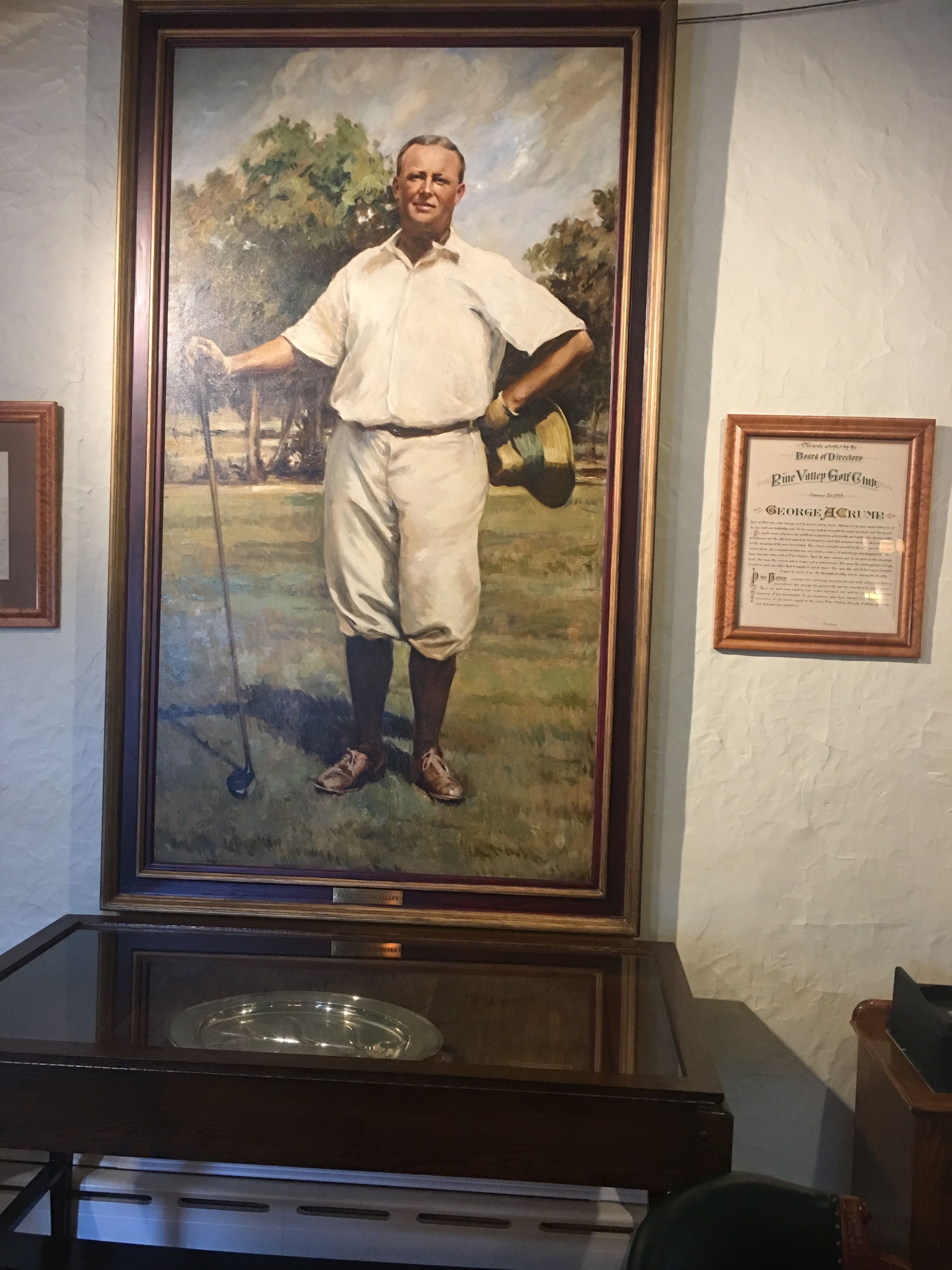
Pine Valley was a labor of love for George Arthur Crump, who was born in Philadelphia in 1871 and lived in Southern New Jersey most of his life. In the early 1900s, he was a member of Philadelphia’s inner circle, or club of competitive amateur golfers (lovers of the game) which included amongst others, A.W. Tillinghast. They would travel to “National” competitions to play against teams from Chicago, New York and Boston.
Crump purchased the land in 1912, and with his friends, the club was founded in 1913. The first eleven holes opened for play in 1914. Crump tragically died at an early age (as did his wife, many years earlier) in 1918, when four of the holes were not completed at the time, #’s 12, 13, 14, and the long par-5 15th. They would be finished later in 1922.
Crump was the main architect and deserves most of the credit as he incorporated many of the classic design elements that he learned from his visit over the pond to the heathland near London years prior. That said, he surrounded himself with a “dream team” of other designers. H.S. Colt was a paid consultant. Others on the team that collaborated included: A. W. Tillinghast, Hugh Wilson, George Thomas, Jr, William Fownes, William Flynn (all five being from Philadelphia), CH Alison, Perry Maxwell, Walter Travis, C.B. MacDonald, Donald Ross, Dr. Alistair MacKenzie, and Robert Hunter.
One of the many reasons Pine Valley is unique is that it was George Arthur Crump’s first and only golf course design. It truly was his labor of love. He found and purchased the property, lived on-site, oversaw the excavation and cleaning/prepping of the property. It is said that the marshlands had to be drained, and thousands of tree stumps pulled—in other words, a lot of earthmoving which really was not prevalent nor easy in the early 1900s.
He dumped all his money into the project, created the routing, and managed the construction of fourteen of the holes prior to his death in 1918. It is said that he also produced the plan and routing the 13th.
Ross, MacKenzie, MacDonald, Alison, Tillinghast—most of the great designers of the day descended upon Pine Valley to study it and lavish praise on the new gem. It would be declared everything from the greatest new course to the greatest course in America, to the finest in the World, which it remains today.
George Arthur Crump, the man behind Pine Valley
Course Review:
As you approach the entrance and gate at Pine Valley, you cannot help but have goosebumps, as well as a nervous feeling in your gut. At the point when the gentleman at the front gate acknowledges your tee time, gives you directions and a lay of the land (it is a huge property of some six hundred acres) and waves you forward, you realize it is not a dream. We could breathe. A warm feeling of jubilation runs through your body, and shit-grinning smiles came over all our faces. I have been fortunate enough to experience that feeling twice now and absolutely cannot wait to do it again.
Make sure you get there early, and soak in the ambiance. The warm, dedicated, proud staff could not have been any more welcoming. It is a huge property and includes a short course, and a driving range—which, has no rival. We made a beeline for the range, a drive from the clubhouse—for a great warm-up and sand practice. Pine Valley oozes “old school” from every pore. From the entrance to the clubhouse, locker room and guest rooms upstairs, and my favorite the library, with 100’s of books on golf.
Oh, then there is the course itself. Pure joy, pure golf. Just like we always preach, we walked the course with caddies—as you can imagine, again, old school, with no (buggies) carts allowed. So much like all the classic links courses we have walked over the pond.
Best Practice Range ever
There are many reasons why Pine Valley Golf Club is perennially rated as the best in the World. It is one of the few wonderfully beautiful, difficult unique and diverse golf courses anywhere. It shines in every category: design & architecture, routing, natural setting, beauty & aesthetics, challenging greens, shot value & strategies, well designed memorable holes, and difficulty.
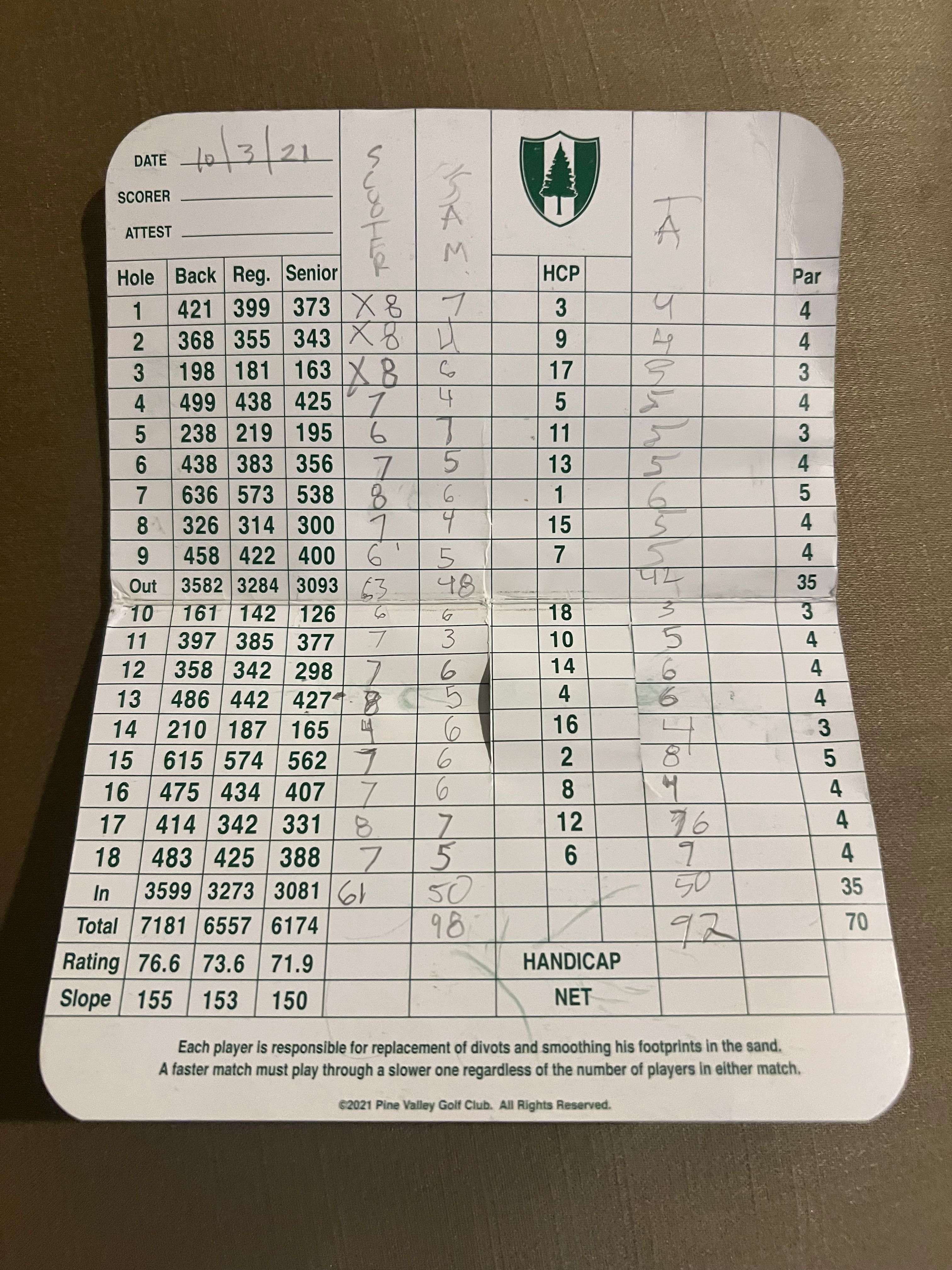
In my opinion, we can attribute that to George Arthur Crump’s unique goals that he laid out while designing Pine Valley: no hole should be laid out parallel to the next, and no more than two consecutive holes should play in the same direction. In addition, players should not be able to see any hole other than the one they are playing. He was successful in every one of those principals. His last goal? Make sure the players use every club in their bag. Even with today’s club and ball technology, the par-5 7th and 15th play 636 and 615 yards respectively from the back tees-enough to scare a 10-handicap like me.
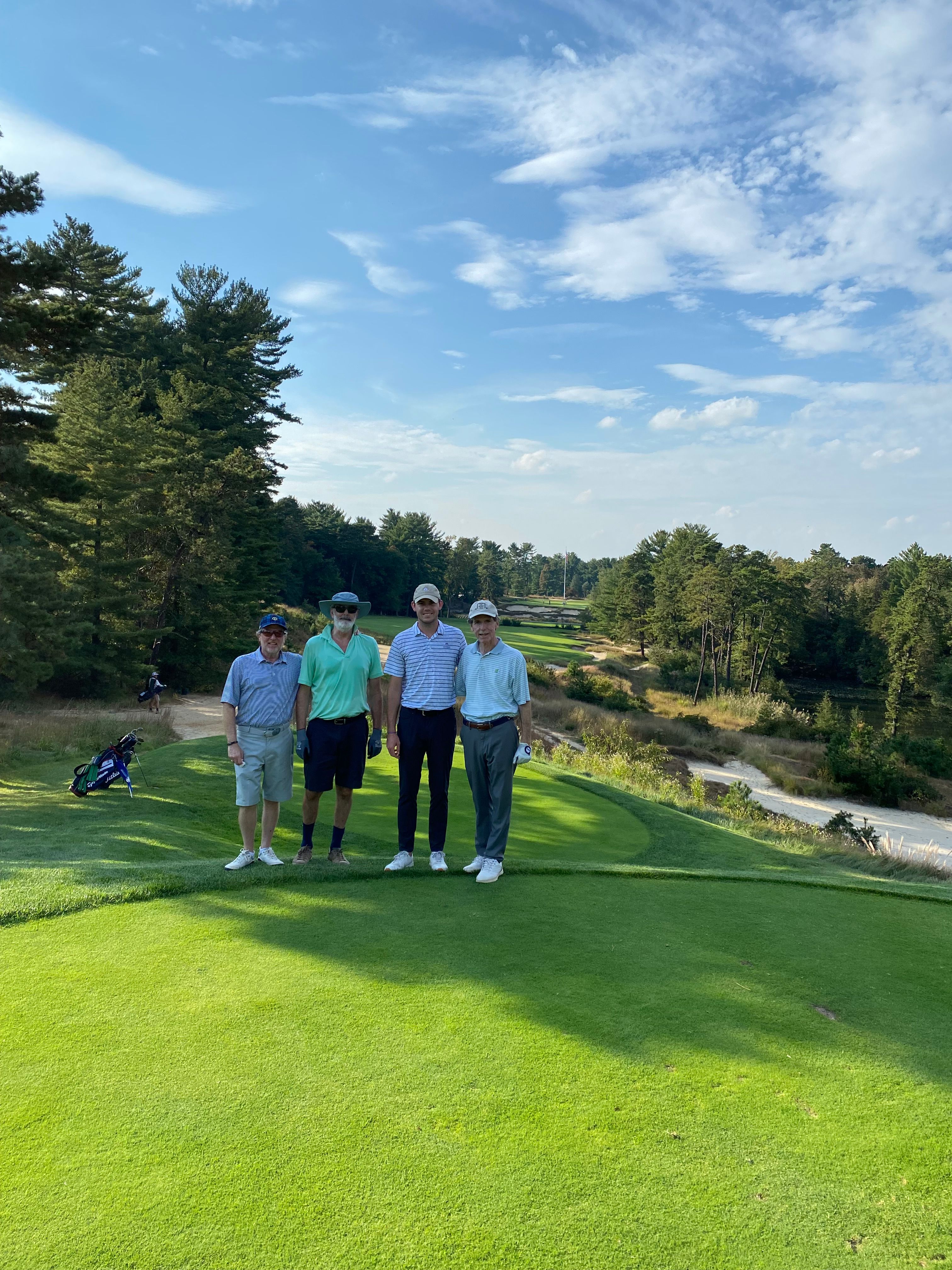
As I walked its fairways, there was a feeling of calmness and being in the moment. I felt as if our group was the only one on the golf course! I never saw anyone until #10 tee, when we took a group photo, looking down and backwards up #18 fairway. It was amazing, and it lends to being in the moment. A golfing meditative state of mind if you will.
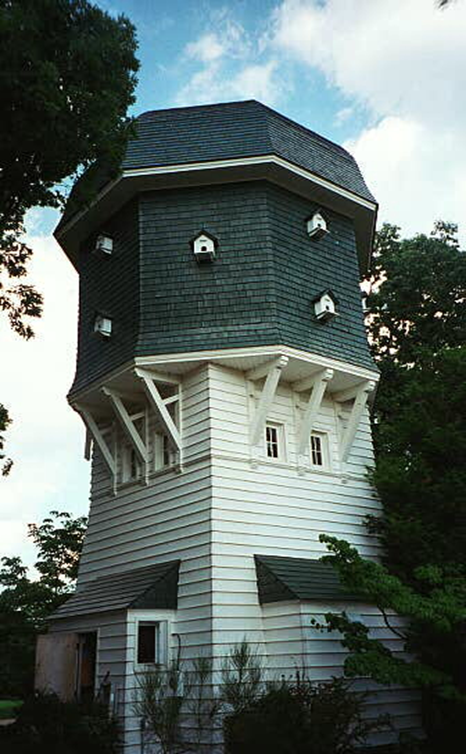
One can argue that Pine Valley has the best set of Par-3’s in the World. Or the best set of (only 2) par five’s—which fittingly, are the #1 and 2 handicap holes. Or, better yet, the best set of diverse, unique (12 of them) two-shotters you will every experience—long, brutish par-4’s and short, strategic ones that are really fun to play. It was as if each hole was its own scene in a movie. Or think of it as an 18-act play, complete with an intermission at the old Dutch water tower-turned snack shack from #11 green.
Dutch inspired Water Tower, Snack Shack
If you are anything like me, you might periodically think back on a course that you played six months ago, and typically forget a few specific holes here and there, or they tend to blend? Not so at Pine Valley, I can remember every aspect of every hole—the fairway, views, terrain, bunkers (moonscapes) and green complexes. That speaks volumes as to why it is the greatest golf course in the World—or one of them.
As to the concept of having a few favorite holes or stretch of holes like I do when I am writing course reviews or talking to folks at the 19th hole, I am hard-pressed to do so with Pine Valley. They are all great, and I love every one of them for their design, uniqueness, aesthetics and shot value and strategy. It reminds me of our conversation with Liam Campbell—a member of Cruden Bay--at St. Olaf’s pub, the night after we had played the course.
“Do you want me to tell ye my favorite holes at Cruden Bay?” he asked. He then continued, counting with his fingers as he spoke. “My favorite holes are hole #1, hole #2, hole #3, hole #4, hole #5, hole #6, hole #7, hole #8” on and on and on till he got to “and hole #18.”
At Pine Valley, I honestly cannot tell you my what my favorite nine was, front or back, it is a toss-up. Nor can I settle on my favorite stretch of holes. Although I do agree with our friend Michael (a long-standing member) when he says that holes 12-17 are the best stretch of holes in golf—it very well could be. One could also argue that same premise about Holes 4-8, or 8-13, or 7-11 for that matter. You get the point. Every hole could be one of the best if inserted into any other golf course.
If someone held a gun to my head and I had to pick an arbitrary nine of my favorite holes at Pine Valley, my answer right now (which could be different if you ask me a month from now), holes #2, #3, #5, #7 (or #6) #8, #11, #13, #16 and #17. All strategic, well designed holes, with two par-3's and a par-5--let's count #7 so we have a par-5 in there.
As a result, I am going to break away from my typical course reviews and talk about every hole, since they are all special.
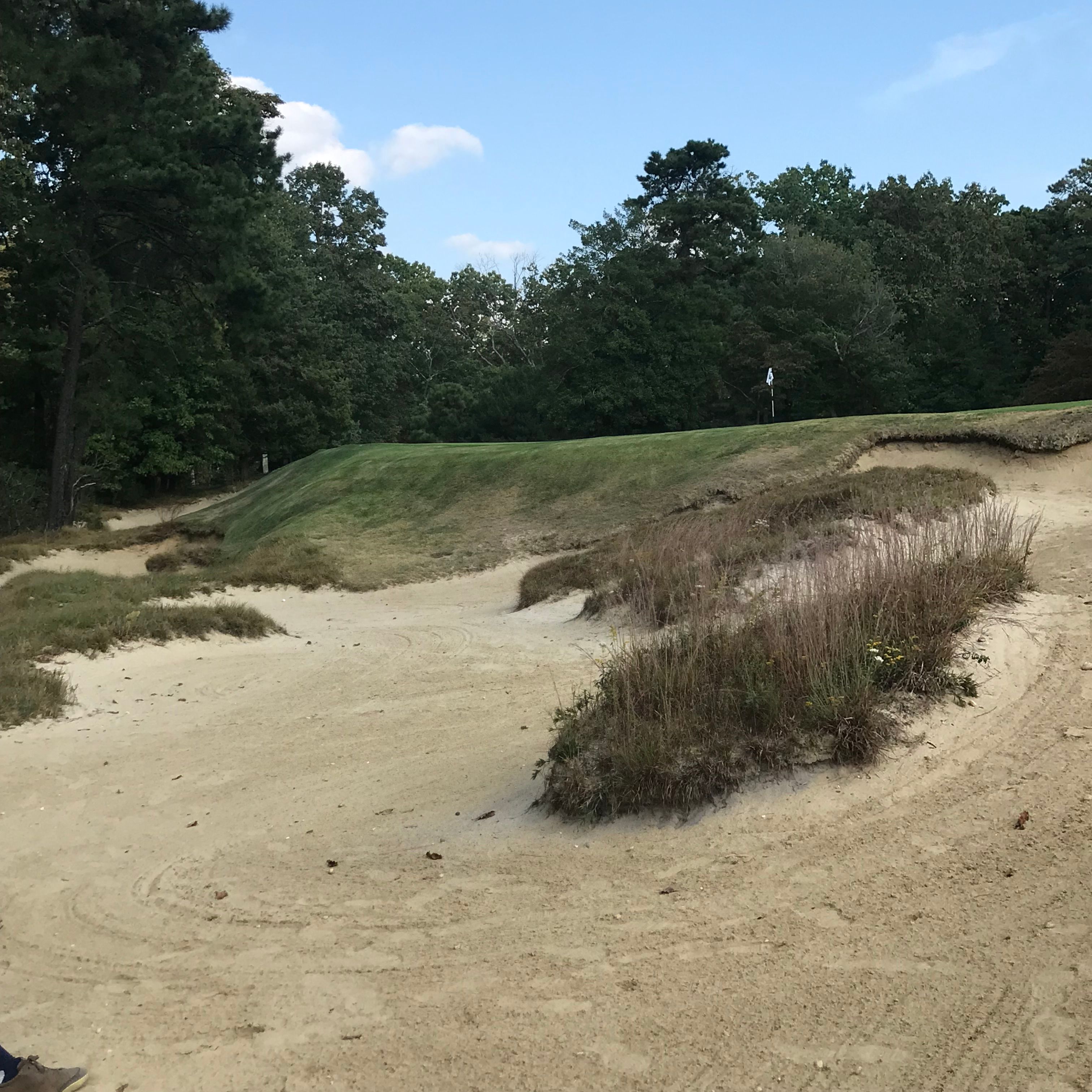
Many people over the years have said that there are no real bunkers on Pine Valley, rather it is all sand, interrupted with occasional patches of grass. They do not have rakes in any of the bunkers or sand waste areas; they simply ask that you smooth over the footprints as best you can after your shot.
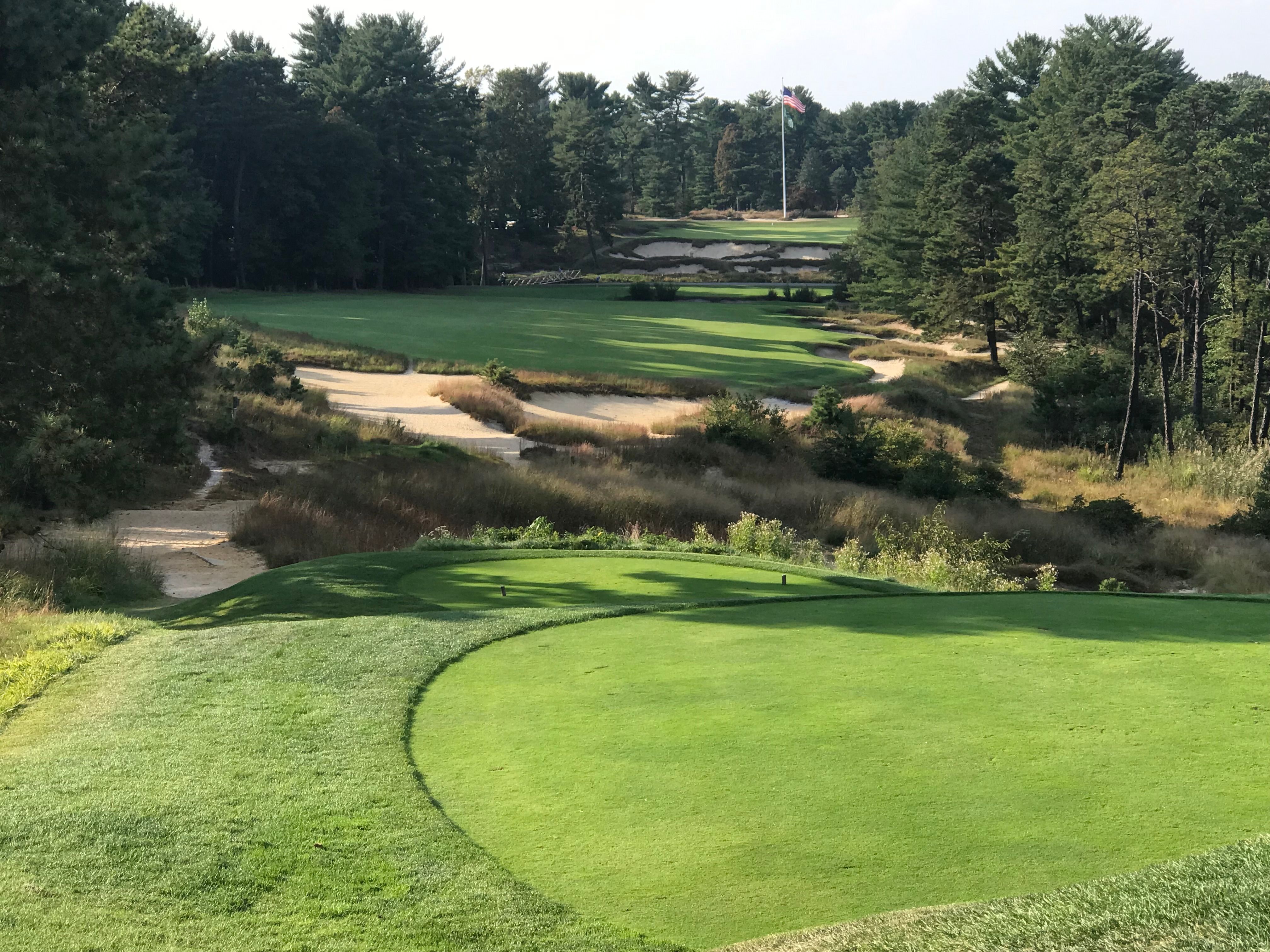
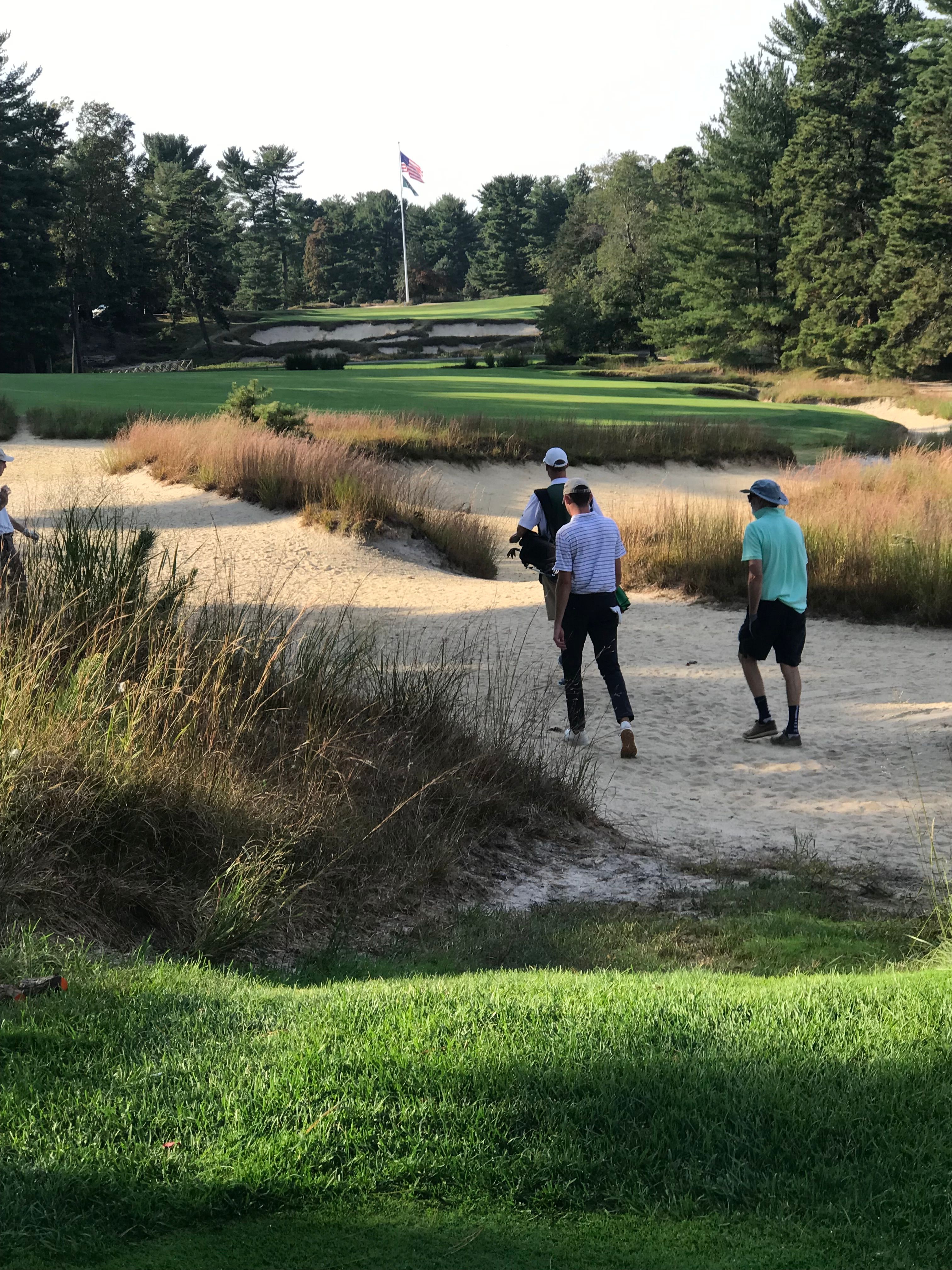
As you put your peg in the ground on the 1st, you take a deep breath and pretend that you are ready for the battle ahead, albeit a fun one. You look ahead at a huge waste bunker to hit over. You mind goes to ‘just get your drive over a sand waste area, and in the fairway. Sand lines both sides of the fairway. Simply stripe it in the middle, then all you have to do is navigate your approach to a green that drops off a steep ledge to the back and right sides. Good luck, and welcome to your shot at a double bogey, out of the gates!
Number 2, at 368-yards, is both beautiful and treacherous You must hit the fairway, which is some 30-yards wide, and lined the entire length on both sides with sandy mayhem. Your approach is uphill and the last 40 yards is all a sandy moonscape--they actually look other-worldly. You absolutely must hit the green, and there is no bailout. In my last round there, I remember finding the right side of the fairway, just off the edge, and Michael’s words were: “Play an extra club Red, it is wicked uphill.”
He was right and my 7-iron barely cleared the sand and would up on the front fringe and I escaped with a par, which is amazing on this hole. This green is huge with rippling waves or mounds, and very few straight putts. My thoughts were many, but mostly what an absolute beautiful, maniacal hole and design by Crump!
I wish I had taken a video! Easily one of the top par-4 holes in the World! Pine Valley did not name its holes on the scorecard, but if it were up to me, I would call it “Mayhem”
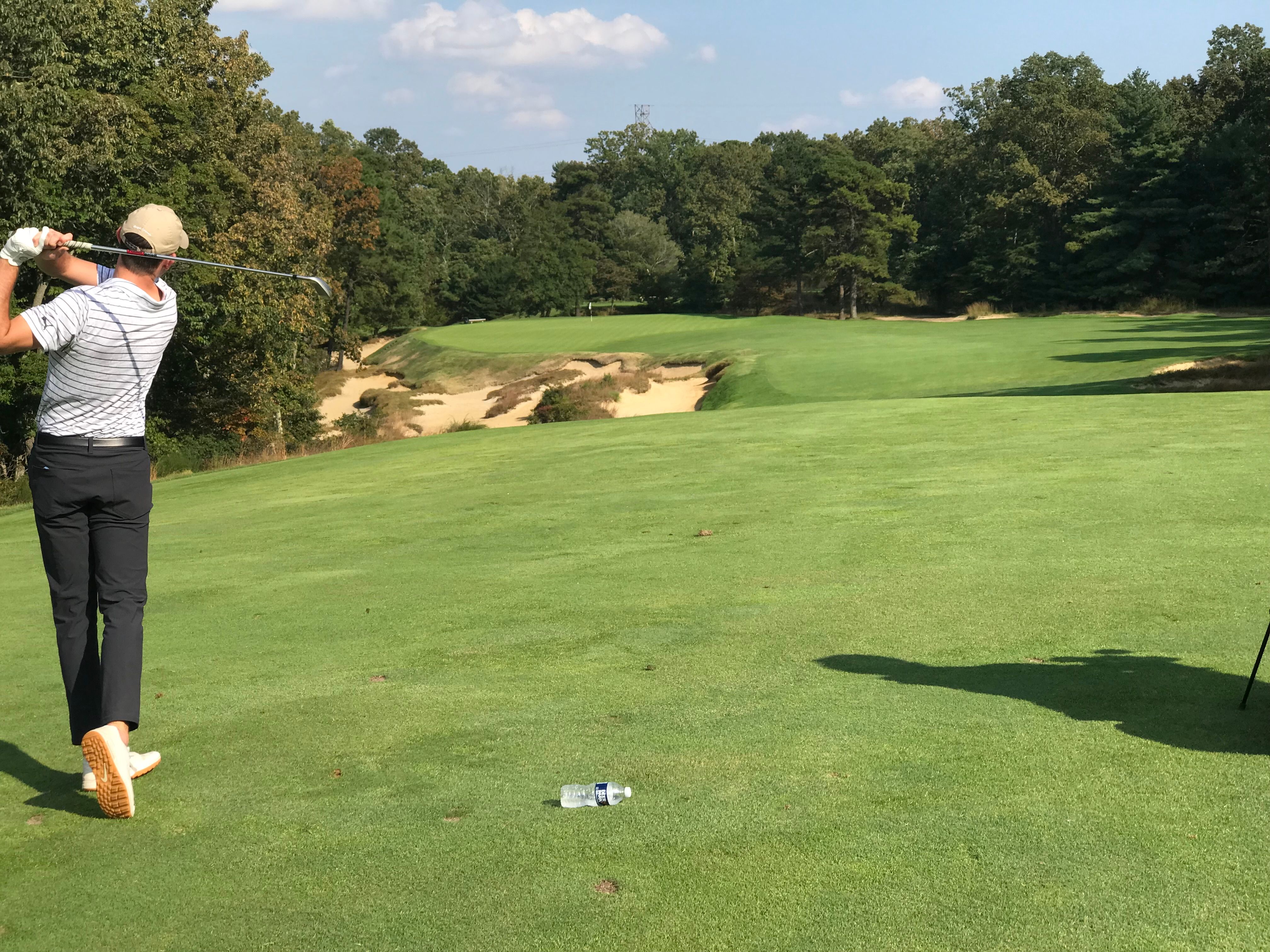
The 3rd is the first par-3, of what I believe is the best set of four one-shotters in the World. It is a beautiful downhill, amphitheater of a hole. Sand and fescue clumps line the hole from tee to green. The green is huge and shaped like an 8, or skull—it leans right to left. It plays 198 from the tips, and 163 from the Seniors tee. There is absolutely no bail out, so pucker up and hit a golf shot! The first time we played it, Johnny stepped up, nutted an 8-iron that hit the slope, up and right of the front pin, and it trickled down for what seems like 5 minutes, and rimmed the cup, almost going in for an ace. Whereas the back left pin position makes it longer, it is fun and gives those that can draw the ball a great strategy to chase it back there. My name for this hole, “Pucker-Up.”
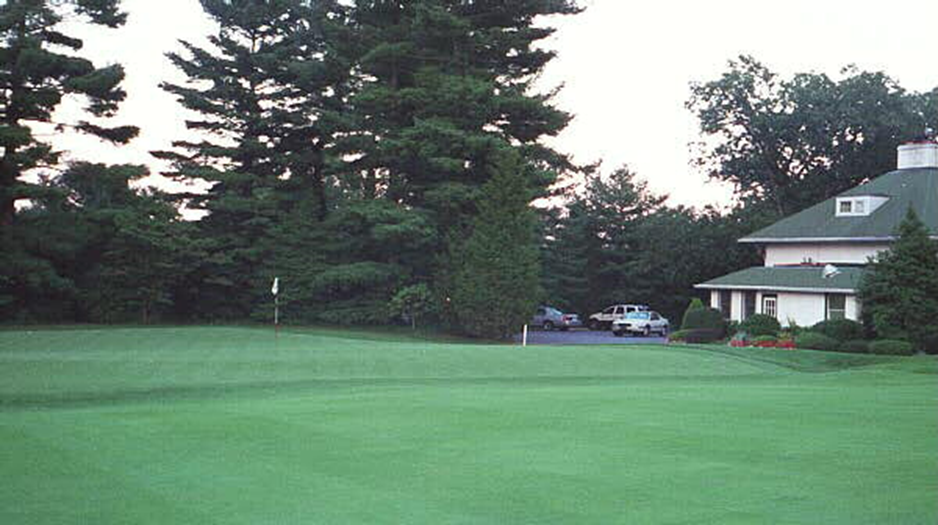
Then comes the forth, a beast of a par 4, at 500 yards from the tips…uphill, blind drive, then it doglegs right and downhill with the clubhouse off the right side of the green. It is all about getting your tee shot out far enough on the dogleg to give yourself a good angle to the green. I still had a long iron in which I managed to get just short and right of the green for a low punch ‘n run shot. You cannot do that on every hole, but there are a handful that you can--numbers 1, 6 and 12 being a few examples.
4th green, open for a punch shot front and right--a big push could hit the clubhouse
The 5th is a scary, behemoth of a par-3, and easily the most intimidating tee shot I have ever seen on a long par three. At 238 from tips--we played it at a mere 195--it is over a pond, uphill, with a complex of bunkers lining the last 40 yards on the left, with a sheer drop off right which is absolute jail with deep bunkers and trees. This was a Harry Colt designed hole, and he suggested to Crump to move green complex further back, at the crest of the hill. Great idea! It is equally as strategic and beautiful as it is difficult. Both times I have played it, I have opted for the left miss, getting up and down for par once.
The Beautiful par-3, 5th
The 6th is a Cape hole design, with a great angle, dogleg to the right. Off the tee, you must carry the scrub area in front of you which is only about a 150-yard carry. You simply need to bite off as much to the right as you take. Trust your caddie! The green is well bunkered on both sides, but you can run one up the front if necessary.
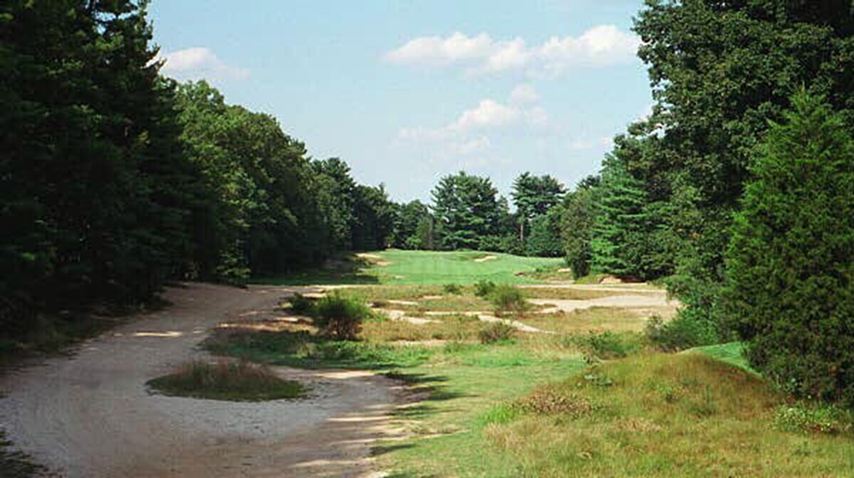
Just when you think you have survived, and need a break, along comes the par-5 seventh, the number 1 handicap hole, and longest at 636-yards from the tips (100 less for the seniors). Oh, and did I mention that this is the famous Hell’s Half Acre hole? It is one of the very few flat holes on the course, lined by trees on both sides, the half-acre of sand, scrub and bushes bisects the fairway--as does the road--running from 280-380 yards out—putting pressure on your second shot. Even after you negotiate Hell’s Half-Acre, on your third shot to the green there is another mammoth bunker the last 25 yards, fronting the green. As you putt out and take a deep breath, you can spot the windmill tower-turned snack shack off the left side of the fairway—it comes in handy for a libation as you leave the 11th and head to the 12th tee.
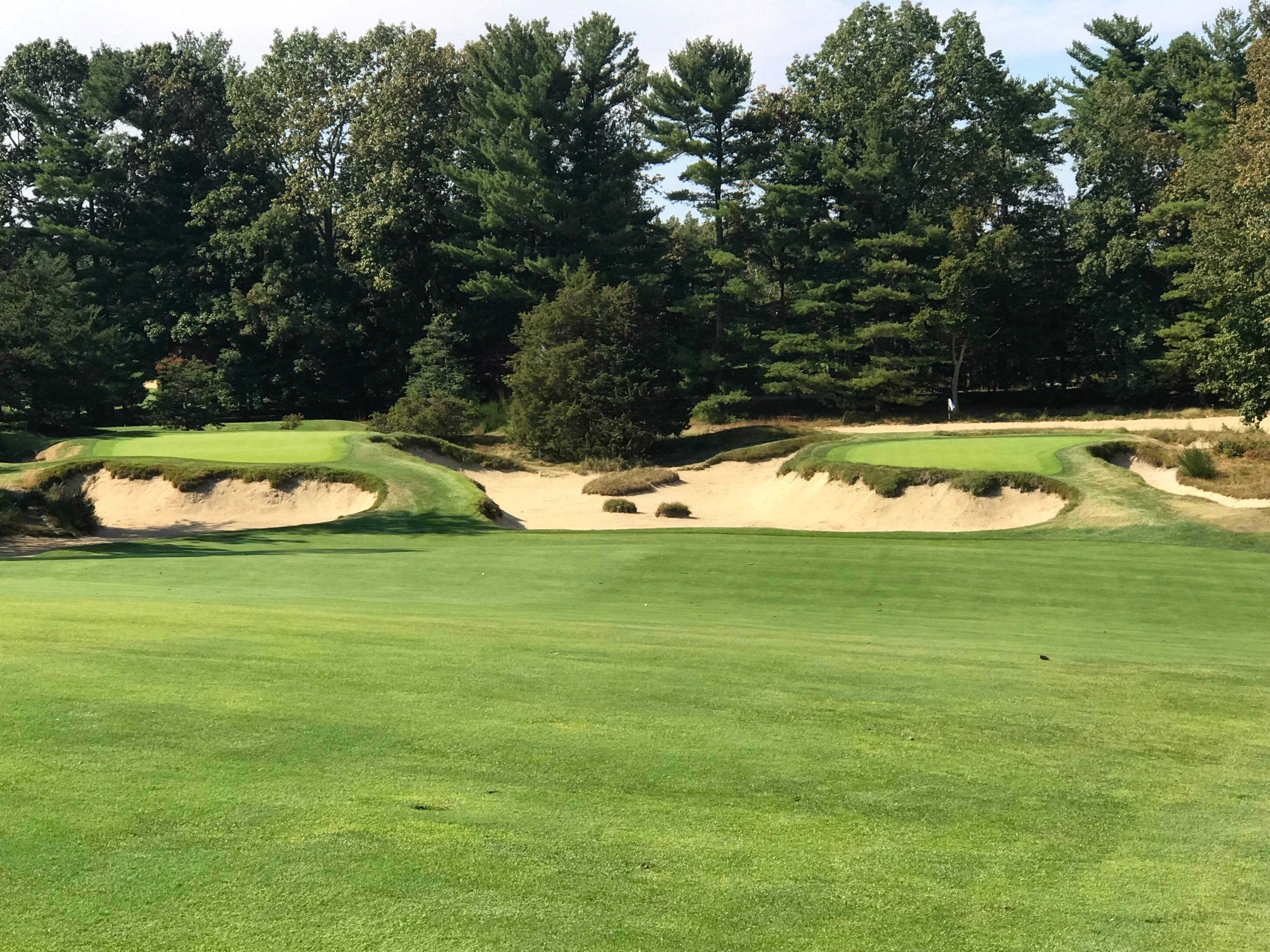
Number 8 remains one of my favorite holes and par-4s on the course—along with numbers 11 & 13. It is a creative, fun hole to play at a mere 326 yards from the tips, with two greens. There are no flat lies on this hole, so expect a side, or downhill lie on your approach. No matter what, it will be the most challenging wedge shot that you will ever hit--a side or downhill to the elevated, narrow green(s) that has a false-front. Good luck! It is a beautiful, strategic hole, and a fun design. I wish every course had a short two-shotter like this—and the modern architects have adopted this strategy/philosophy (Doak, C&C, Hanse, et. al). The left green is the original, the right one being added in the 1980’s. They are separated by a 20 yards or so of sand. This hole is a testament to Crump’s design strategy to have good mix of both short and long holes, on both the par-4’s (12th and 17th) as well as the par-3’s (#10 being a mere 126 yards). Another way that they made this hole difficult was the tiny green, the total opposite of the typical large to huge greens at Pine Valley. The icing on the cake is that both greens are elevated and surrounded by sand, with false fronts was well!
#8 double-greens, look at the small size and elevation
Number 9 is a double green as well, the one on the left, the original, looks like an infinity green, blending into the horizon and dropping off down to the 18th fairway. This is a straight hole, to a blind fairway—similar to #’s 4, and 9--you will not necessarily see your ball land. The double greens act to give you more angled approach shots—again, a brilliant design feature that I have not really seen duplicated on many other courses.
#9, "blind" landing area-Old photo prior to clearing the trees behind the green,
As you make the turn (right), you are some 450 yards from the clubhouse--down the hill and back left up #18. As they cleared a lot of the trees behind #9, the tee on #10 is a great, high vantage point look back up #18 fairway below you. Ten is a short par-3 at 126-yards from the up tees. It is Pine Valley’s shortest hole, and their own version of the Postage Stamp at Royal Troon. It is downhill as well, to a somewhat small green in width, and well bunkered on all sides. You will want to make sure you miss the famous Devil’s Ass Hole lurking on the front right, a bottomless pit of a bunker, at least 10-12 feet below the putting surface. Scooter happened to find it the first time we played it and miraculously got out onto the green with one swing. My name for this one is right in front of you, Devil’s Ass Hole.
Unfortunately, Scooter found the Devil's Ass Hole Bunker on #10
The view down to #18 from the 10th Tee
Number 11, a par-4 at 380-yards is yet another masterpiece, a Picasso or Monet amongst 18 beautiful canvases. It is yet another amphitheater of trees and sand that plays with your mind. It zigs left then zags right, then straight into the green complex, which is open in the front and center left, but loaded with bunkers everywhere else. It also fools you into thinking that it is a big, wide target area off the tee only to realize when you get there, it is just baiting you to run into tree trouble. There are two huge bunkers 30-40 yards short of the green complex that play with your eyes and must be negotiated if you have a wayward tee ball. If I had to name this one, I would call it Trickery.
At this point you can talk yourself into “I think I deserve a cocktail.” The snack shack awaits you, but little do you know you after your next hole, you descend smack into the Amen Corner of Pine Valley after number 12.
Twelve, one of the other short two-shotters, is an intimidating hole visually, but just a straight-forward good drive down the right center and a pitch from there to leaving you a putt for a birdie—the last chance you will have till #17. Focus, hit a good drive, and the hole turns left for a great angle and straight on to the green—it slopes heavily front to back. That said, it is hard not to focus on the deep cavernous bunkers, or dunescape/moonscape as I mentioned earlier that run the entire length of the hole on the left.
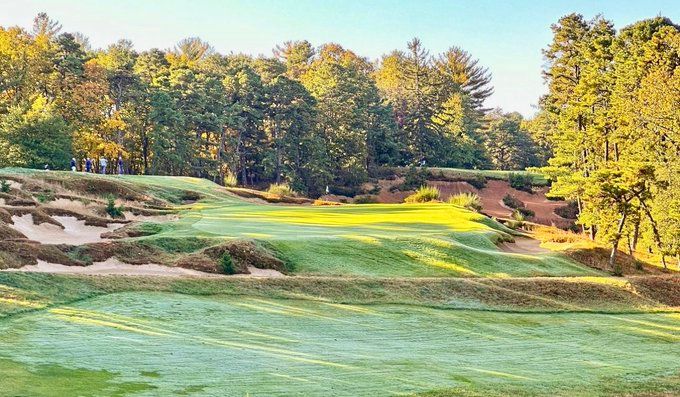
The first of the Pine Valley Shuffle (Amen Corner) is the 13th is a real gem of a par-4, along with 8 and 11 that I mentioned earlier. At 486 from the tips, the fairway is a roller-coaster up to a plateaued landing area then downhill and left to the green, well-guarded by huge, deep bunkers short and long left (at least 20’ below the green. Do I try the hero shot and go at the pin, or bail right? A great strategic hole—my name for it, I Dare You.
Approach to #13, "Dare you to go for the pin!"
Miss the 13th anywhere short or long left and you're in jail
If you miss the 13th anywhere short left, you are doomed!
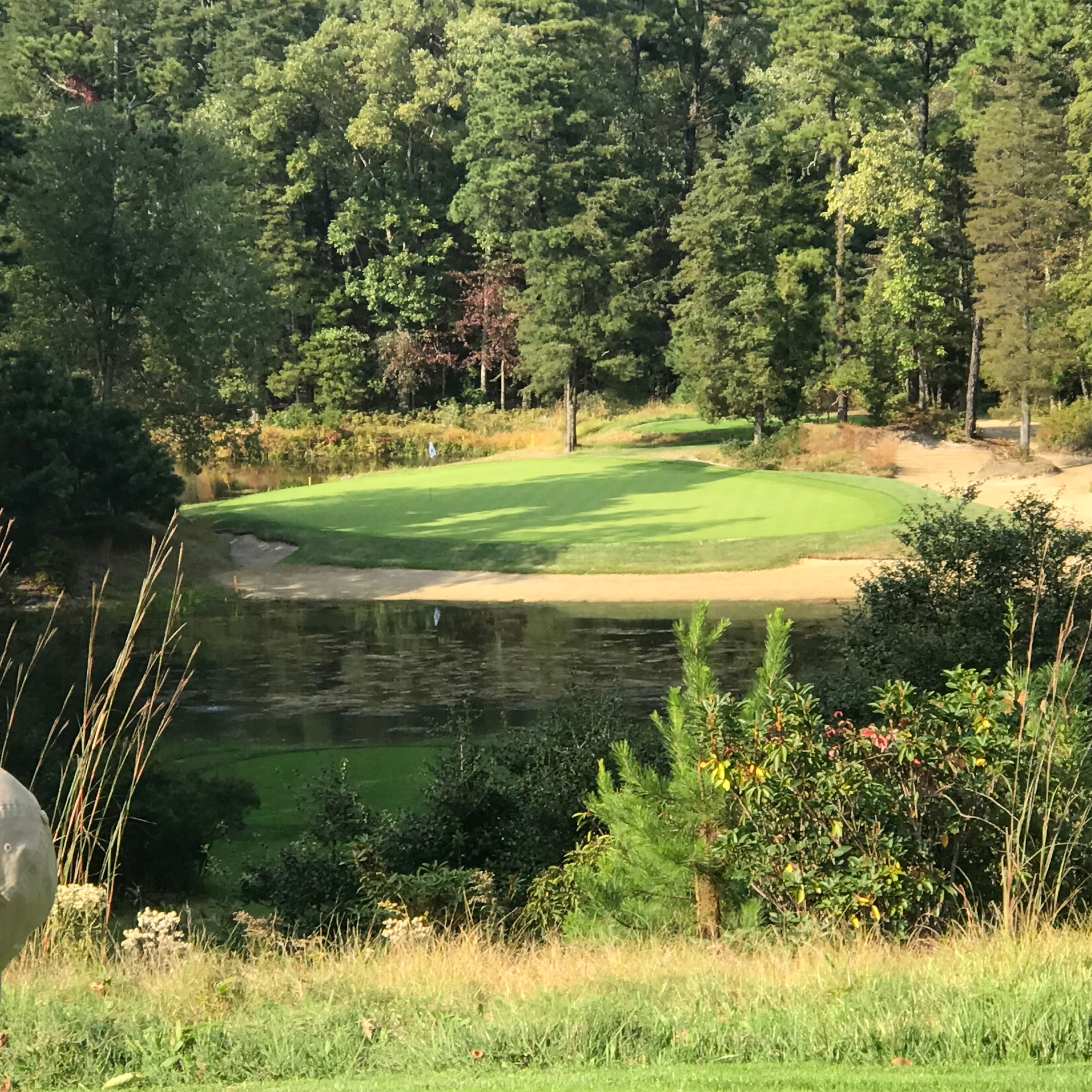
Then comes a wonderful par-3, #14. Downhill through a shoot, surrounded by trees, over the edge of the lake, surrounded by a beach-like bunker on three sides. Like #3 in that there is no bailout, buck-up and hit a golf shot! It has terraced tee positions that put you anywhere from 165 to 210 yards from the target, through a shoot of tree. It is a pretty hole, with lots of trouble lurking—just like #12 on Amen Corner at Augusta.
Beautiful par-3, 14th (PV's 2nd hole on its Amen Corner)
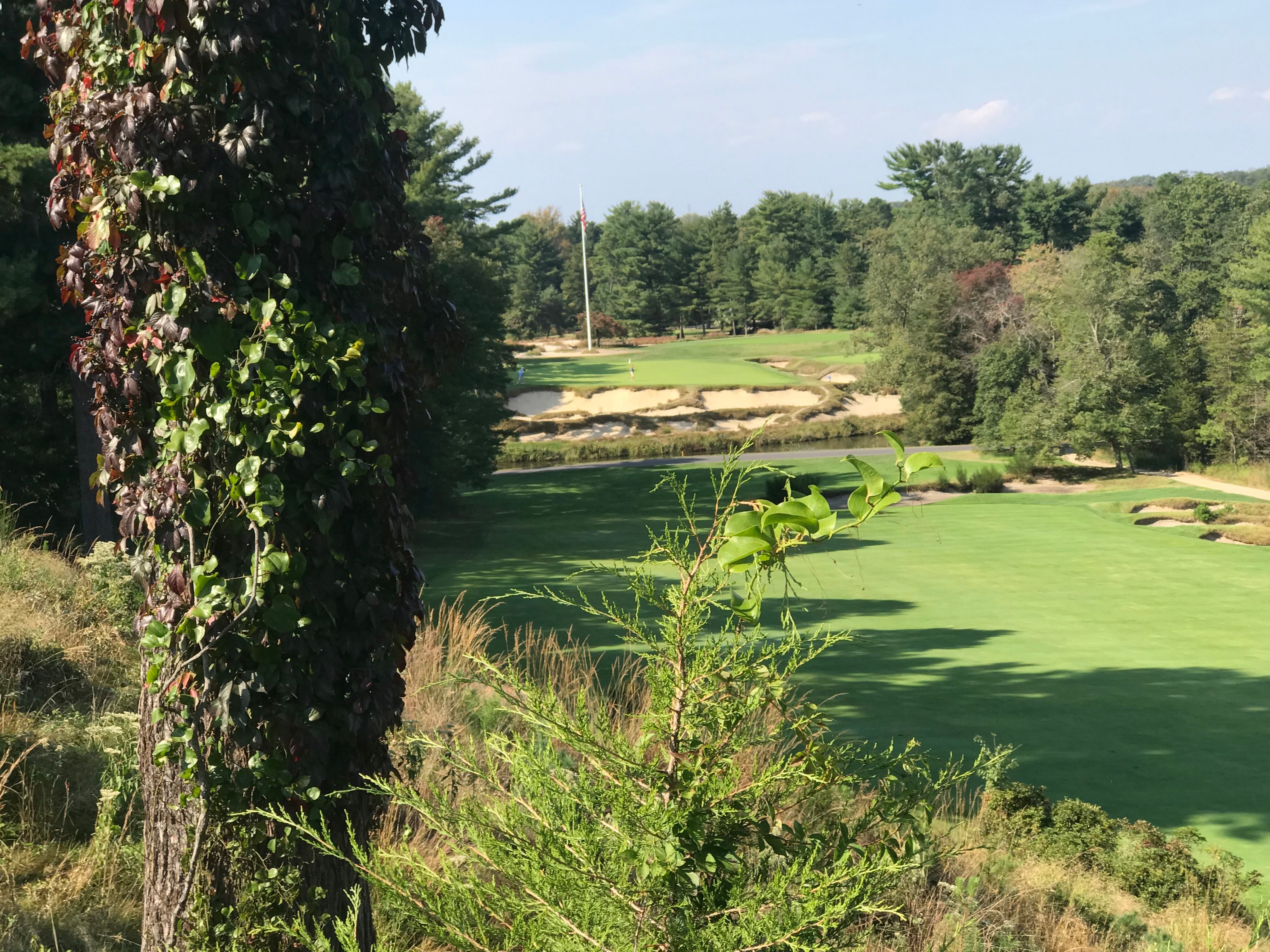
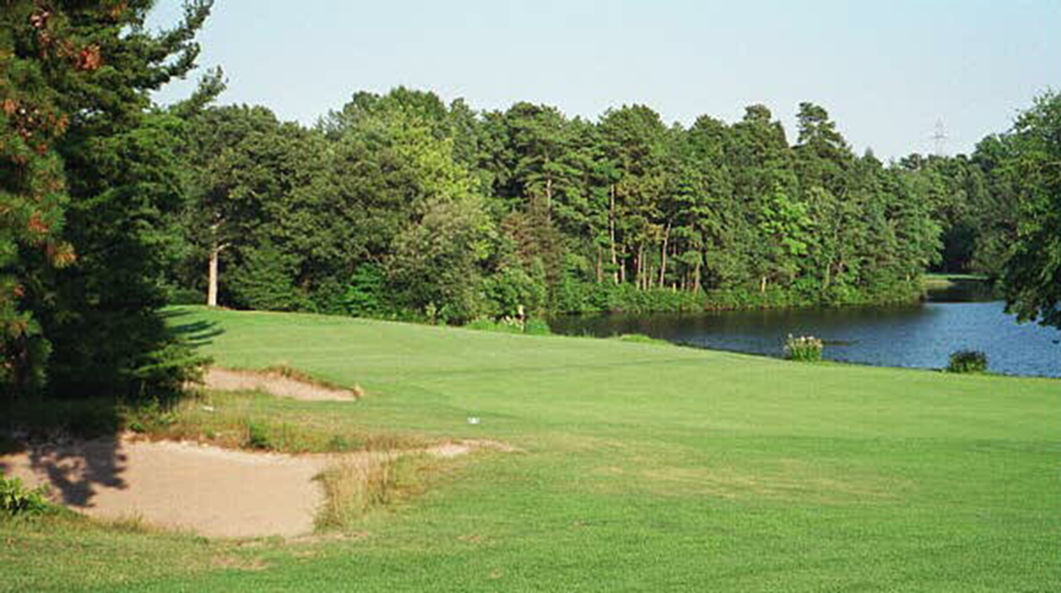
Then, how about a smack in the chops to end off the Pine Valley shuffle (Amen Corner)? Number 15, the 2nd and last of the par-5’s is another beautiful monster of a hole, 615 yards from the tips, just a bit shorter than number seven. The drive goes over the lake, and uphill all the way to the green.
After your tee ball, you walk across the wooden bridge, to the left of the tee, over the pond then through the trees to the beginning of the fairway. It is the very same wooden bridge that, as the story goes, Bobby Jones walked over and had a meditative moment of calm and a resulting epiphany. It would bring him out of his slump to go on and win the US Amateur, the final leg of his Grand Slam in 1930. I certainly think that it is an incredibly special walk, and on the Zen scale, I cannot come up with one post tee-shot walk that comes anywhere close to this one. Just a little stroll over a lake and through the woods to calm the nerves for the last four-hole stretch.
The landing area for your tee shot is very wide, then the fairway narrows the closer you get to the green, down to 20 yards wide. Its lined by trees on both sides, some overhanging the fairway, and following along with every other hole, a dunescape/moonscape stretch of bunkers on both sides the last 60-70 yards to the green.
I will admit it; I was mentally and physically exhausted as we trudged up the fairway and putted-out on 15. I took a few deep breaths and prepped for the wonderful last three holes. I also thought about how Pine Valley was designed to be both strategic and penal. Sometimes you must step up and try to be a hero, others, just simply survive the hole. That said, you always need to string together two good consecutive shots, and there simply are not any holes or shots on which you can relax.
#16, runs from 400 to 475 yards depending upon the tee. It is all about the angle, diagonal, of the fairway, and howe much you can bite off on your drive. Like many other holes, you tee off through a beautiful shoot of trees, and over another wasteland/moonscape. The fairway slopes right to left, then downhill toward the green complex, which is absolutely huge, and looked like it was 40-yards deep. It was one of my favorites that I’ve every played. It reminded me that you cannot just pat yourself on the back when you hit a green at Pine Valley, you need to get it to the correct spot to come close to being able to two putt.
Pull your approach left and you hit one of the bunkers, too far right, and you will tumble down into the lake—it looks like the green simply blends into the water. I remember hitting my approach just short of the green to the right. I hit my favorite 7-iron punch ‘n run, approximately 140 feet for a tap-in par. What a fun, well-designed hole. The diagonal fairway reminded me of #6 the par-4 Cape hole, which ran diagonally left to right in the same manner.
Wonderful 16th, its huge green looks like its falling into the lake
Then comes another one of the great short, two-shotters, #17, at 331-yards from the up tees, with a new back tee behind 16 green stretching it to 414 yards. It was nice of Mr. Crump to give the golfer a shot at another birdie on the way, I certainly appreciated it! It is a slight dogleg right, surrounded by sand on both sides of the landing area. You are approach is uphill over moonscape/dunescape, exactly like #2.
Our Foursome on the 18th
When you arrive on the 18th tee, you cannot help but smile. What an absolute beauty, and the greatest inland finishing hole in golf At a mere 483 yards from the tips It is an uphill drive to a plateaued fairway—but first you must carry the sand/scrubland. It plays much longer than the yardage on the card. Then you go over sand—of course--then rough, then water (same pond/burn as #5) then another sandy moonscape/dunescape sharply up the hill to the green. It has some serious slope, back to front. Lastly, if it were up to me, I would call this hole “Hallelujah.”
18th, the best finishing hole in golf
18th, did we hit the fairway?
Golf, as we all know is the thrill of battle one wages with the course (Mother Nature), and with oneself. I am not sure which challenge is greater at Pine Valley, which speaks volumes to how cool the course really is. It is a difficult grind, but a fabulously wonderful one and a beautiful walk at that. Thank you, George Arthur Crump!
Our friend Michael (a long-standing, proud member at Pine Valley) was not only a gracious host, but a blast to play golf with and a ‘historian’ and story teller of everything that is Pine Valley.
As we walked off the 18th, we all exclaimed to our caddies, and Michael, “Get me to the 19th, I think I need a libation!”