
Enniscrone Golf Club
Eddie Hackett & Daniel Steele
A wonderful links course in County Sligo, on the Atlantic Ocean. It has the tallest, most wonderful dunes in all of Ireland



Ireland | Par 71 | 7377 Yards
Pat Ruddy
History:
The European Club is the lifelong masterpiece of renowned Irish golf architect Pat Ruddy — a course conceived with passion, crafted with precision and refined over decades. For more than thirty years, Ruddy has remained a devoted steward of the links, personally shaping its evolution to meet the demands of the modern game. Here, today’s champions are invited to express their brilliance, but only those with a thoughtful, strategic approach will truly conquer their challenges.
Year after year, Ruddy continued to guide enhancements to the course, ensuring it remains as exhilarating and relevant as ever. Few courses in the world enjoy such enduring attention from their original designer — with Donald Ross at Pinehurst being one of the few historic parallels. The result is an ever-evolving, world-class links — one that many regard as the finest of its kind.
The dream began in 1958, when a young Ruddy was inspired by the story of Jimmy Demaret and Jack Burke creating The Champions Club in Texas. Determined to one day create a masterpiece of his own, Ruddy embarked on an aerial survey of Ireland’s coastline in search of the perfect setting. His search led him to the majestic dunes of Brittas Bay, just thirty miles south of Dublin — a landscape destined for greatness.
Golf course design has been part of Pat Ruddy’s life since childhood, with his first professional commission at Castlecomer in 1969. Since then, he has earned global recognition as one of the foremost designers of true links golf. Today, the European Club stands as his crowning achievement — a living expression of artistry, innovation, and an unwavering love of the game.
The Course:
The European Club is the genius and vision of its creator, Pat Ruddy, a golf writer turned architect of some great Irish courses including Ballyliffin, Rosapenna, and Portsalon, to name a few, and this course, his vision and labor of love. It is obvious that he designed the course and surroundings to his liking. It is all about golf. A celebration of golf. Nothing more. Nothing less. Many say that it is the most difficult links course in Ireland—I tend to agree.
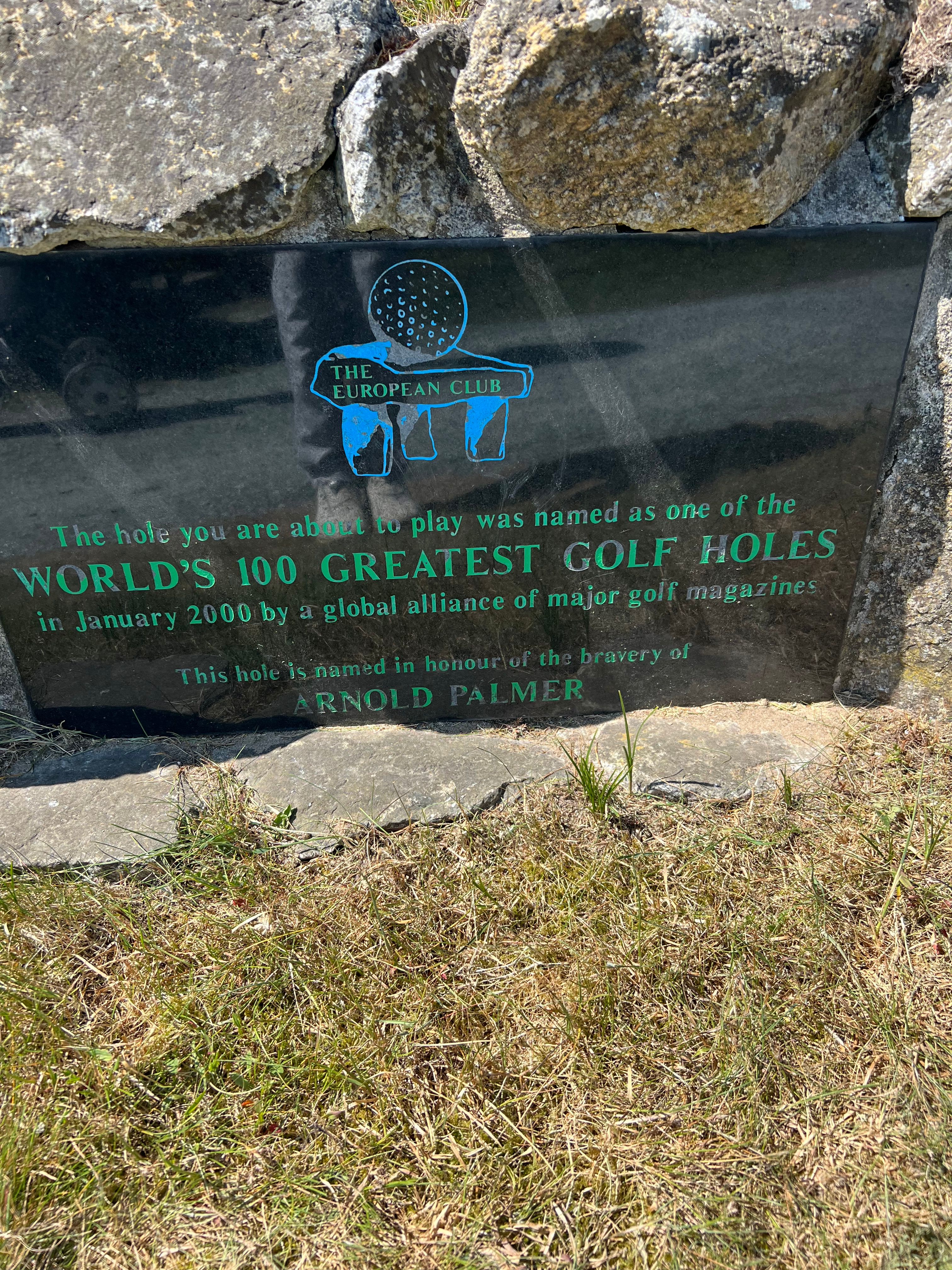
No pretense. No bragging, no multimillion-dollar clubhouse, and restaurant nor a 500-member roster replete with a busy social calendar. Oh, and the logo? Both quirky, like the course, and brilliant! A giant golf ball atop a mini-Stonehenge. That must have been a great dream!
On the first tee, our starter spoke of the Club’s designer/mastermind.
“This is not a true, natural links course that Pat just found, like Old Tom Morris, rather he had access to a bulldozer, and he used it!”
Unlike most classic out ‘n back links layouts, the European Club routes holes in every direction, and #9 heads into the clubhouse. That certainly adds to the difficulty when playing in the wind.
He spoke of the difficult and unique bunkers, they have slanted, vertical barnwood slats that line not only the front of the bunker, but most of the sides as well. Thankfully, he also mentioned a great tip to us.
“If you get frustrated, take a 7-iron and bust it (all ball) at the slats, thereby hitting a bank shot.” Believe me, I incorporated that strategy to my benefit on a couple holes, including the par-3 second, where I smashed the ball fifty-feet in the air only to have it land 3-feet from the cup for a knock-in.
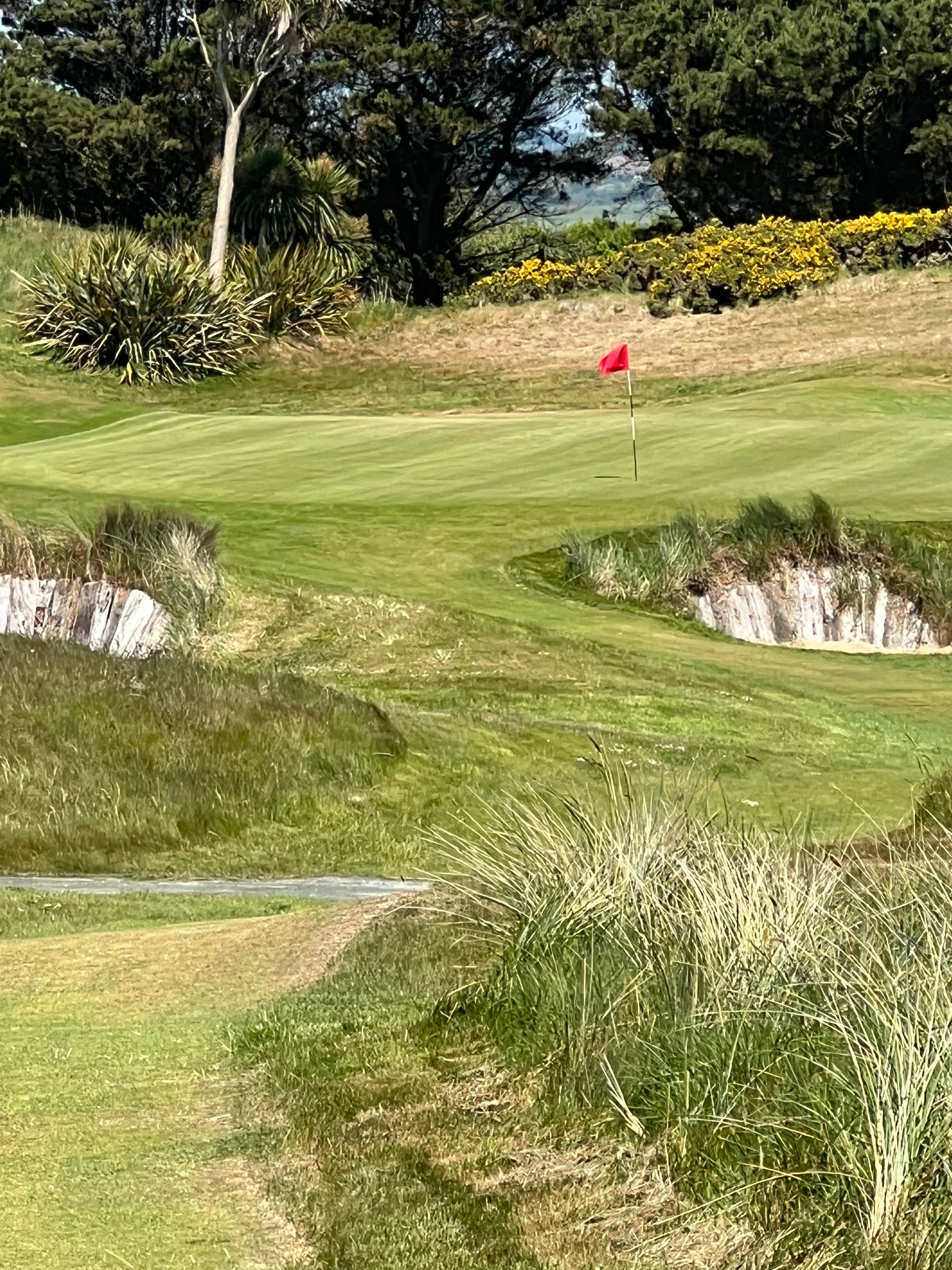
I will admit that the bunkers are beautiful, sculpted, unique bunkers. Many modern architects have paid homage to this design feature. It was a go-to for Pete Dye on many courses, and I love how Gil Hanse incorporated vertical slats at Castle Stuart—and he did not overdo it.
I have always thought that one of the greatest defenses that a links course possesses is the optical illusion. Some courses, and some holes play with your mind as far as the distances. This was certainly the case at The European Club. Countless times we stood on the tee, gazed out at a par-4 and thought, “there is no way that this hole is 370, it looks more like 450 yards!” Or, from the fairway, shaking our head in disbelief with a 9-iron in our hand, thinking we would wind up 30-yards short.
We got into the groove, and the wonderful views. It was a two-and-a-half club wind, and this is a course where your driver must be working—remarkably like Royal County Down from that perspective. Scooter and I both had troubles on the front—and the scorecard reflected that frustration. It had quite a lot of memorable holes, including number three, the sole par-5, a downhill beauty toward the Sea/Brittas Bay.
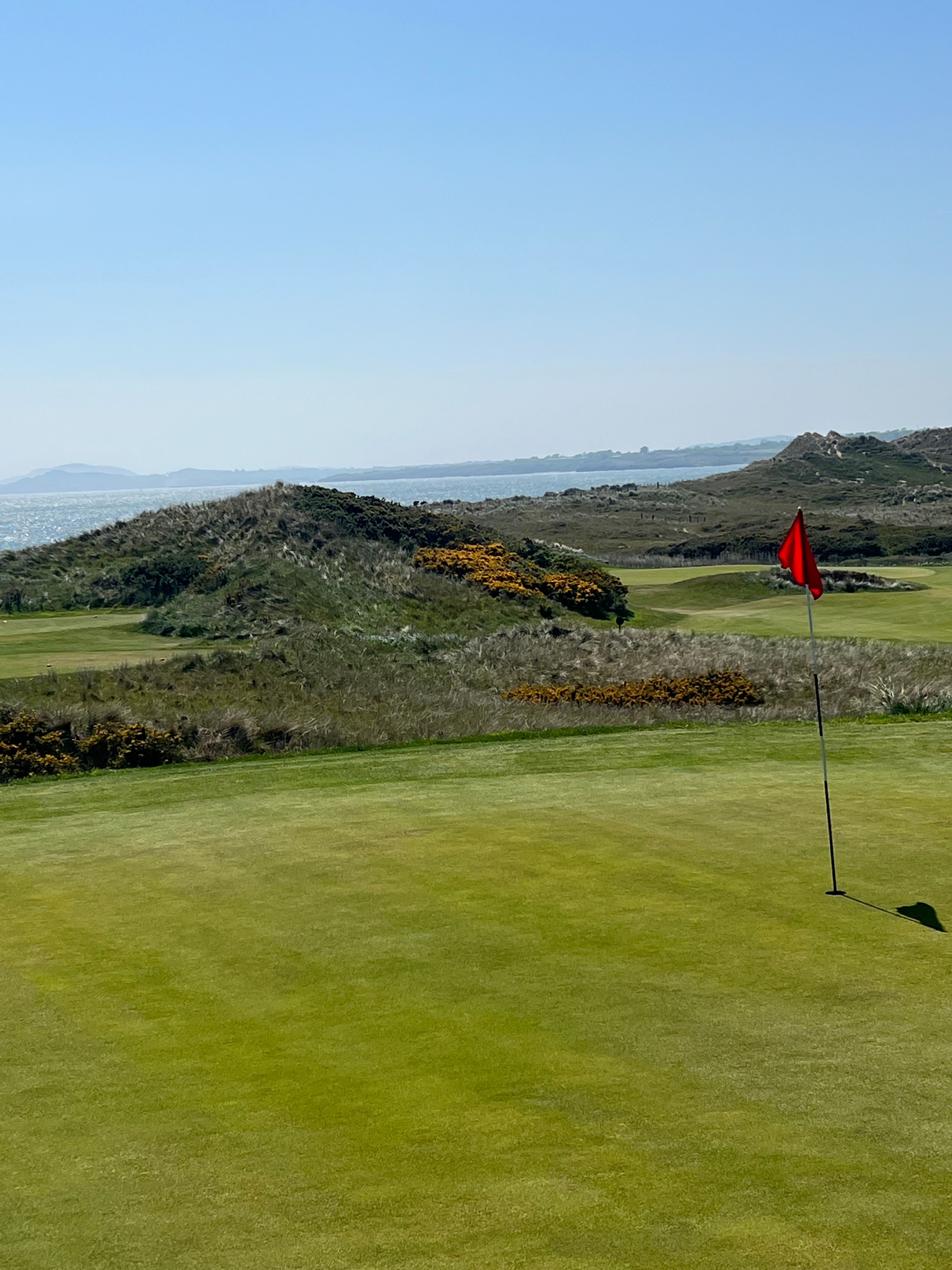
Number six, a 155-yard par-3, into a three-club wind, and number seven (the signature Arnold Palmer plaque hole), a gutsy par-4, and the #1 handicap hole that exudes the waring, do not go right on this hole, especially at the green—of course, I did. This course features twenty holes, with a 7a and 12a, and you can choose to play both or neither one. We wound up playing 7a, a short par-3, at 114 yards, uphill, into a big wind--I smashed a 7-iron to pin high and made par. A fitting example of how in links golf, any given club can have a 70-yard range on any given day.
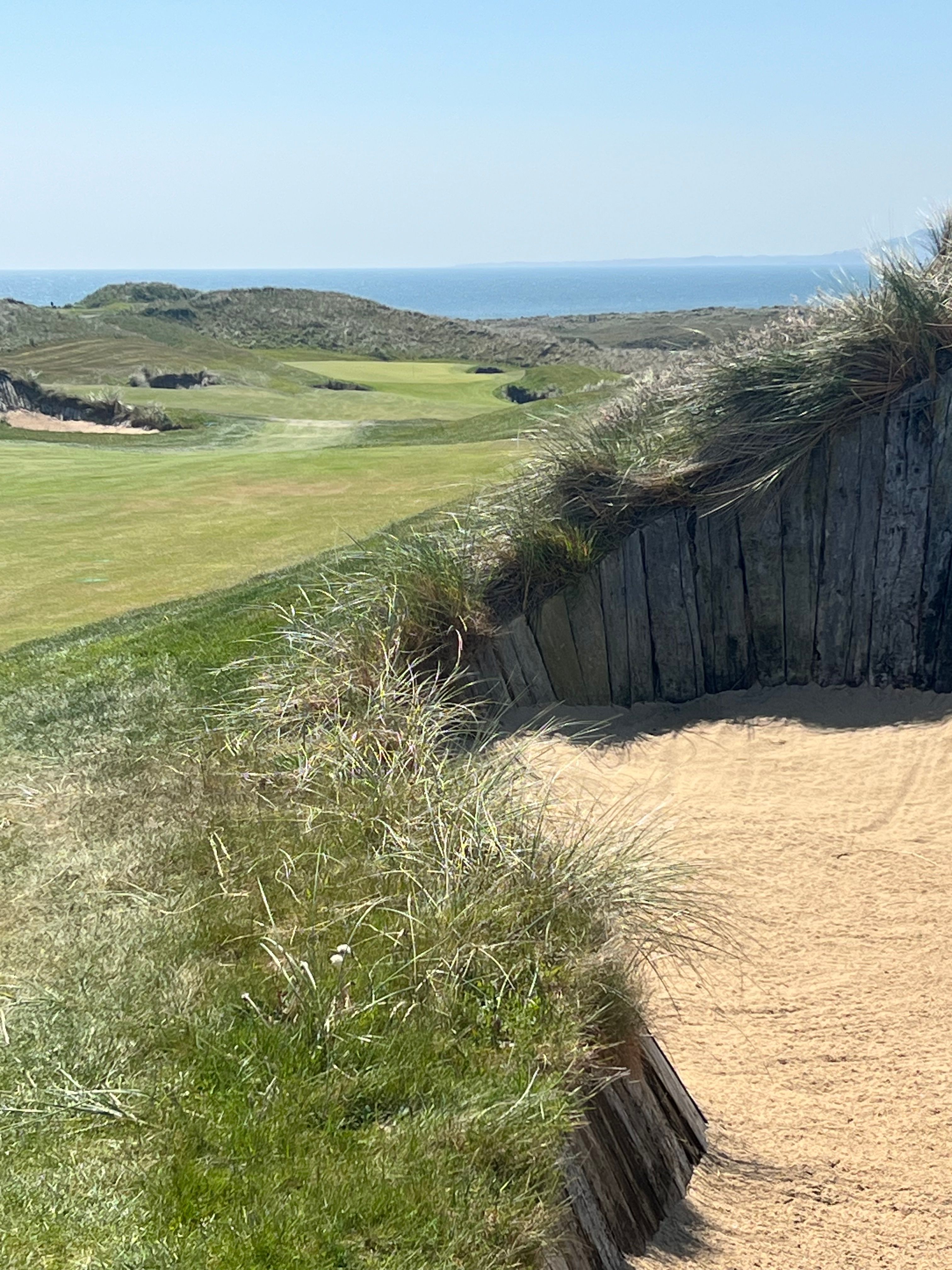
The back nine is the real strength of this course, and one of my favorite nines in Ireland (along with the front at Portrush, and Lahinch, and back at St. Patrick’s and Ballybunion). It opens with a couple fun par-4s that go out to the Irish Sea. Eleven is a well-designed hole, with a couple strategically placed slatted bunkers up the right side requiring you to thread a drive. It is a beautiful approach to a green sloped back to front, guarded on the left by a big dune ready to gobble-up any wayward shot. Brittas Bay and the Irish Sea lie beyond. Leave it to Pat Ruddy!
Twelve though Sixteen is the best stretch, with some fun holes. Twelve’s tee box looks down on the beach below. It is a breath-taking par four at 410 yards (460 for the big hitters) on this day, a left to right wind wreaking havoc the whole way. The green that awaits you is the largest in World at 127 yards deep.
Thirteen, a par-5 at 480 yards (which stretches to over six hundred) is a gorgeous hole, teeing off through a shoot that opens out toward the Brittas Bay and the Irish Sea. After navigating a few strategic fairway bunkers, you approach a huge kidney shaped green that wraps itself around a menacing bunker. If you wind up on the wrong side of pin, or bunker in this case, a wedge from the green comes into play.
Fourteen, an uphill par-3, played tough on this day into a primarily hurting, left-right wind requiring a full bore 175-to-180-yard typical shot going only 130 into the wind. Fifteen was a fun, uphill par-4 that parallels the Sea and ends-up with a green perched on a shelf up above the water—one of the highest points on the course, and the furthest (East) from the clubhouse. A beautiful vista from where to gaze back at the course.
A set of par-4’s ends out the back, each unique in their own way. Sixteen has a grass bunker in the middle of the fairway right around 240 off the tee—in addition to threading the needle through two pot bunkers, right and left. I managed to get a 5-iron (again?) out of a bad lie on the edge of that bunker, into the right-left and some hurting wind and onto the front part of the green. I rang the birdie bell with a fifty-footer—for the first one of our trip.
Seventeen is a brawny 380 yarder, mostly into the wind (on this day, but the prevailing wind would be downwind), through a shoot of dunes, to an unprotected green. Eighteen is an interesting hole. It has a shoot of trees to the left off the tee and an exceedingly difficult drive/landing area. A large dune runs down the left. The green has a quirky, horseshoe.
shaped moat/burn that guards the green. Must have been one of Pat Ruddy’s pet projects.
To Pat Ruddy’s credit, he is not trying to hide the fact that the course is more of a modern links course, like Kingsbarns, or Castle Stuart. Suffice it to say, he used the bulldozer well.
The only complaint I could muster as Scooter and I took the ride back to base camp in Portmarnock—aside from being tired from the long walk—was the overabundance of the beautiful, unique bunkers. I hear that it has over 120, which I think is a lot compared to some of its Irish counterparts: 62 at Royal Portrush, 69 at Royal County Down, and a measly 40 at Ballybunion.
All that said, it is a course that everyone needs to experience at least once. I am not sure what it will be like after the new owner takes over—rumor has it that Pat Ruddy required that “the course could not be altered or re-designed in any way.” That said, it is well worth a trip to The European Club anytime you do a Dublin Links excursion.
Why play there?
I, like others from time to time say that there are two types of golf courses. The ones that you loved to play and will do so as many times as you can. The second kind are those courses that ‘you must-play this one at least once in your life.’ The European Club is one of the latter.
It has no pretense. It is what it is, as Bill Murray would say. A pure, raw, challenging, unique, wonderful, picturesque, difficult, modern-day links course, with beautiful, magical dunes. It kicks your butt from the first tee to the last. But when your last putt drops, you are smiling the whole way to the parking lot.
What makes great courses great? To me, aside from great routing, green complexes, and natural beauty: are they unique? What do Pine Valley, Royal County Down, The Old Course, NGLA and Cypress Point have in common? They are all unique. Have you ever seen anything like Pine Valley? No way!
Course Rating: The European Club is a resounding Birdie!

The scorecard encourages you to “STAY AWAKE-GET AROUND WITHOUT DELAYS-YOU ARE AN ATHELETE!”
— COURSES —
More incredible links courses from Ireland
Eddie Hackett & Daniel Steele
A wonderful links course in County Sligo, on the Atlantic Ocean. It has the tallest, most wonderful dunes in all of Ireland

Harry Colt
A modern-day host on the Open Rota, Royal Portrush is a top-20 course in the World. An absolute must to play. Both challenging and beautiful, with gorgeous views and a great walk. It was named after the Dunluce Castle just down the beach where The Lords of Antrim lived centuries ago.

Original (9) Holes: Lionel Hewson, re-design: Tom Simpson
Ballybunion opened in 1893, laid out by golf writer Lionel Hewson. The club battled early media and financial issues, grew to 18 holes in 1926, and saw minor redesigns by Tom Simpson in 1937.