
Prestwick Golf Club
Old Tom Morris, 1851
An Old Tom Morris designed classic links course that hosted the first 12 Opens, and 24 all told, still rated in the top 70 in the World




Scotland | Par 70 | 6250 Yards
Original: Old Tom Morris / Re-Design: Simpson & Fowler
Course History
There is evidence, in the form of a ballot box inscribed Cruden Golf Club 1791 that a nine-hole golf course existed before the layout of today’s links course. It may have been located at the Ward Hill near Slains Castle, and indeed the Cruden Bay Golf Club of today has in its possession a winner’s medal from a competition played on the Ward Hill dated 1883.
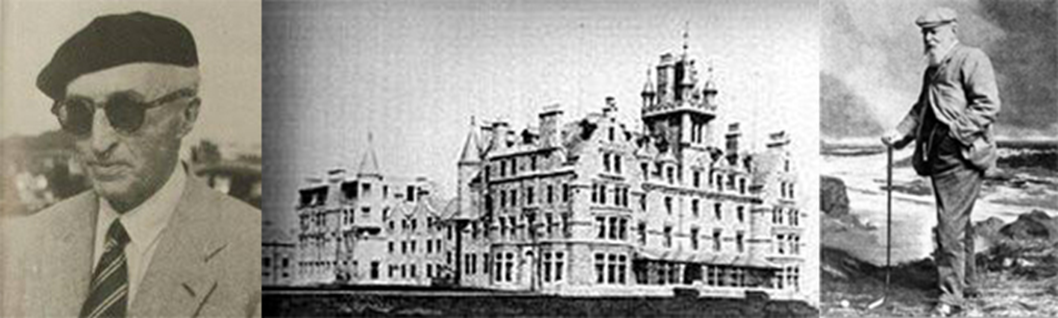
Today’s links course, as we know it, was commissioned in 1894 by the Great North of Scotland Railway Company and fully opened in 1899 as part of the recreational facilities offered by the Cruden Bay Hotel, which was built and opened in March of that same year. The inner nine-hole short course was also laid out at the same time—now known as the St. Olaf’s course.
The course was designed by the very well-known Old Tom Morris of St Andrews, with help from Archie Simpson.
Cruden Bay instantly became a popular destination and a hot-spot for people from all over the World, with the Great North Railway making it easy to get to for those traveling up from England or Scotland.
Its opening was celebrated with an inaugural professional two-day open tournament on 14-15th April 1899, with prizes totaling £120.
The leader after the first day’s play was Harry Vardon of Ganton, with a score of 162, while J Kinnell of Prestwick scored 163, A Simpson of Aberdeen 164 and A Kirkaldy of St Andrews 165. James Braid and Ben Sayers were also in the field.
On the second day the leading four qualifiers went into match play and in the final round Vardon beat Kinnel by 3 and 2.
In 1926 the course was redesigned to the current layout by Tom Simpson and Herbert Fowler. They also redesigned the St Olaf course which was opened at the same time.
By 1908 the course had been extended to 5929 yards, and then in 1926 the partnership of Simpson and Fowler oversaw the redevelopment of the course, although many of Tom Morris’s original greens and basic routing are still in place.
In more recent times small alterations have been made to the course, such as the addition of new tees and bunkers, and the length now stands at 6263 yards.
Course Review:
I had been dreaming of playing Cruden Bay (along with Machrihanish G.C.) for years. Woody was a huge fan of both of those courses, first researching them back when we were in high school, fascinated by Old Tom and his prolific career as a golf course architect.
If you have read any of my blogs or course reviews, you already know that I am a big Old Tom Morris fan—thus my new nickname. Playing all the courses on the Old Tom Morris Trail has become my top goal in links golf. I am lucky enough to have Askernish (most unique and remote), Royal Dornoch, Prestwick, and Machrihanish under my belt, and now Cruden Bay, but I have a long way to go.
Scooter and I walked Cruden Bay on a lovely, warm, Friday late afternoon. We were the last group out for the day. Not only was I not disappointed, but I was also downright giddy! What a wonderful, joyous links golf course. It checks all the boxes for me:
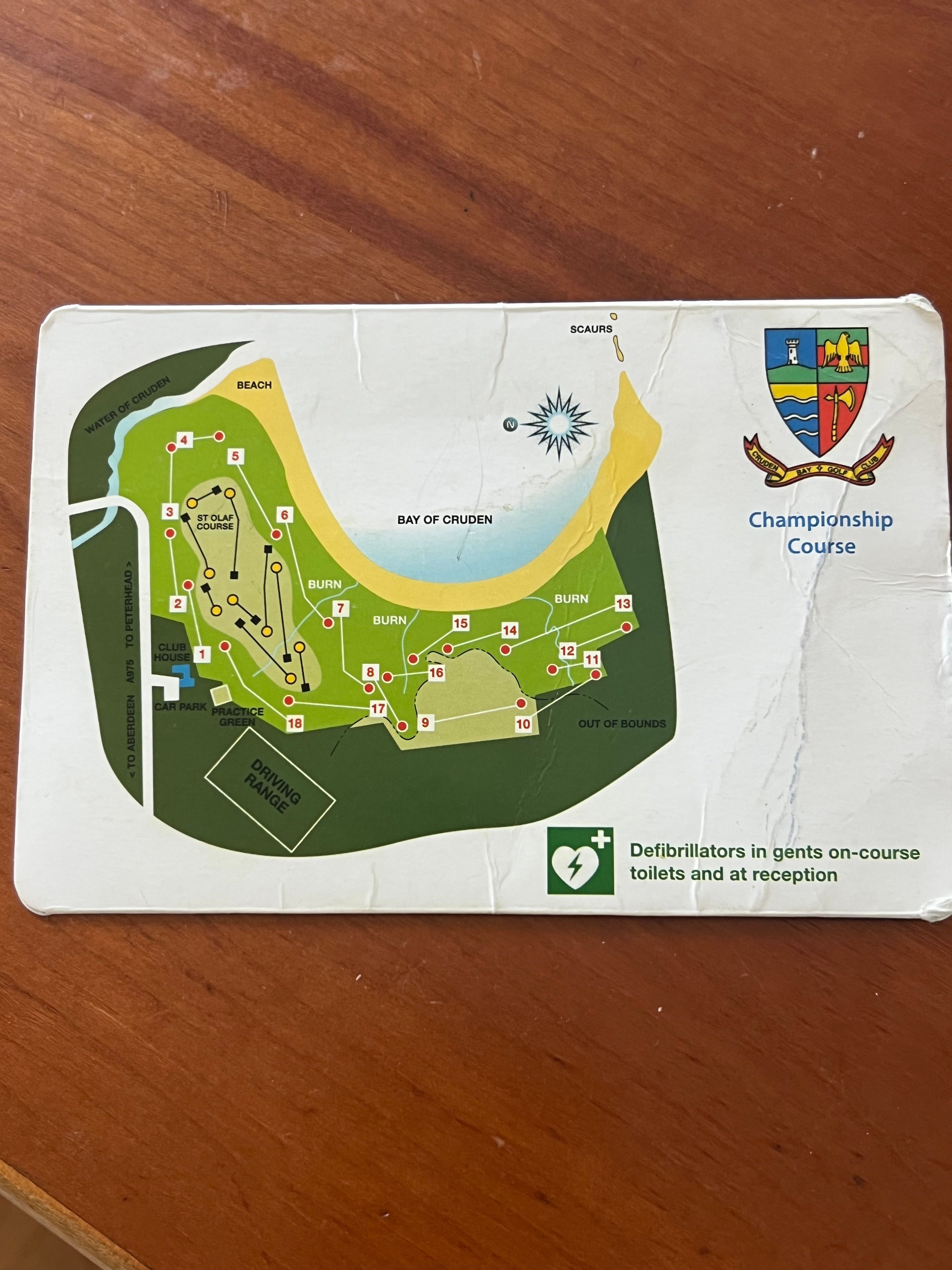
It is a roller coaster ride around, through and at times over massive, ancient sand dunes. Old Tom Morris “found” some great, natural green complexes (#’s 4, 5, 6, 7, 8, 14, 16, 17) and simply routed hole along, up and over the dunes, all with picks, shovels and donkeys. It is marvelous and a joy to play.
The course includes three burns, heather, scrub, short holes, long holes, punchbowls, beaches, waves and a view of Slains Castle in the distance—the inspiration for Bram Stoker’s Dracula. Cruden Bay has it all! Even a long uphill walk over the towering dune that backs to the 8th green, 9th tee, and left side of numbers 14 (punchbowl) and 15. No gondola or funicular here. We climbed that mountainous dune for what seemed like a good ten minutes to arrive at the nineth tee—with glorious 360-degree views, well worth the work.
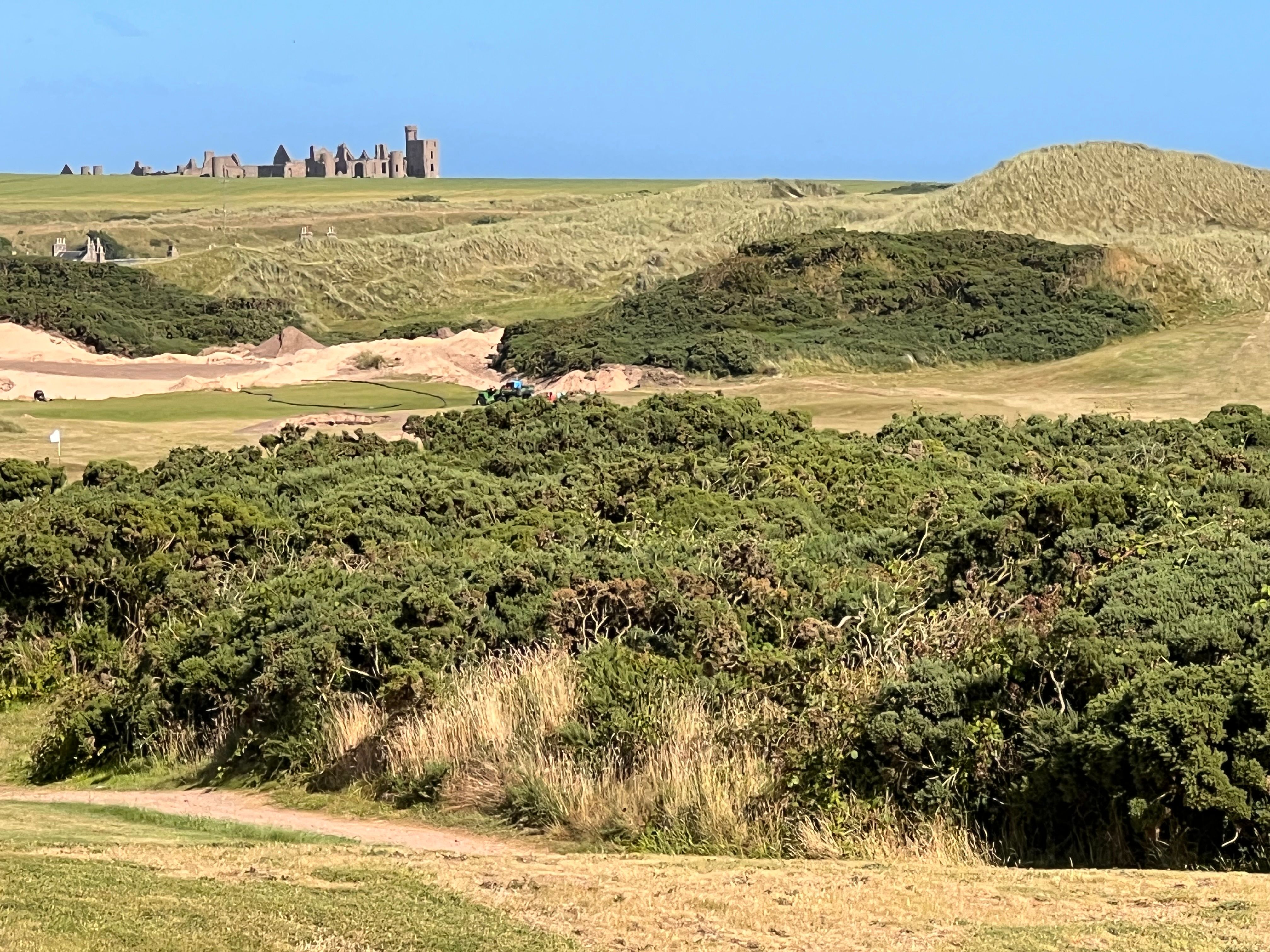
The front nine begins with a couple gentle handshakes at par-four. Number 2 is an interesting short two-shotter, yet very strategic. A long iron or 3-wood drive leaves you with a wedge to the green. The fairway is lined all the way on the left side with shrubs and gorse, and that temps you to favor the right side, but the fairway slopes left to right, so you need to pick a good line and pipe it straight. A draw off the tee would be a great play. The green complex is plateaued, and drops off significantly to the right and rear, with three strategically placed pot bunkers left, and one short right down the hill. There is no miss—you do not want to go right or long and you certainly do not want to go left, and guess what? Short is bad also. So, stand up and hit a golf shot! A well designed and a fun hole to play,
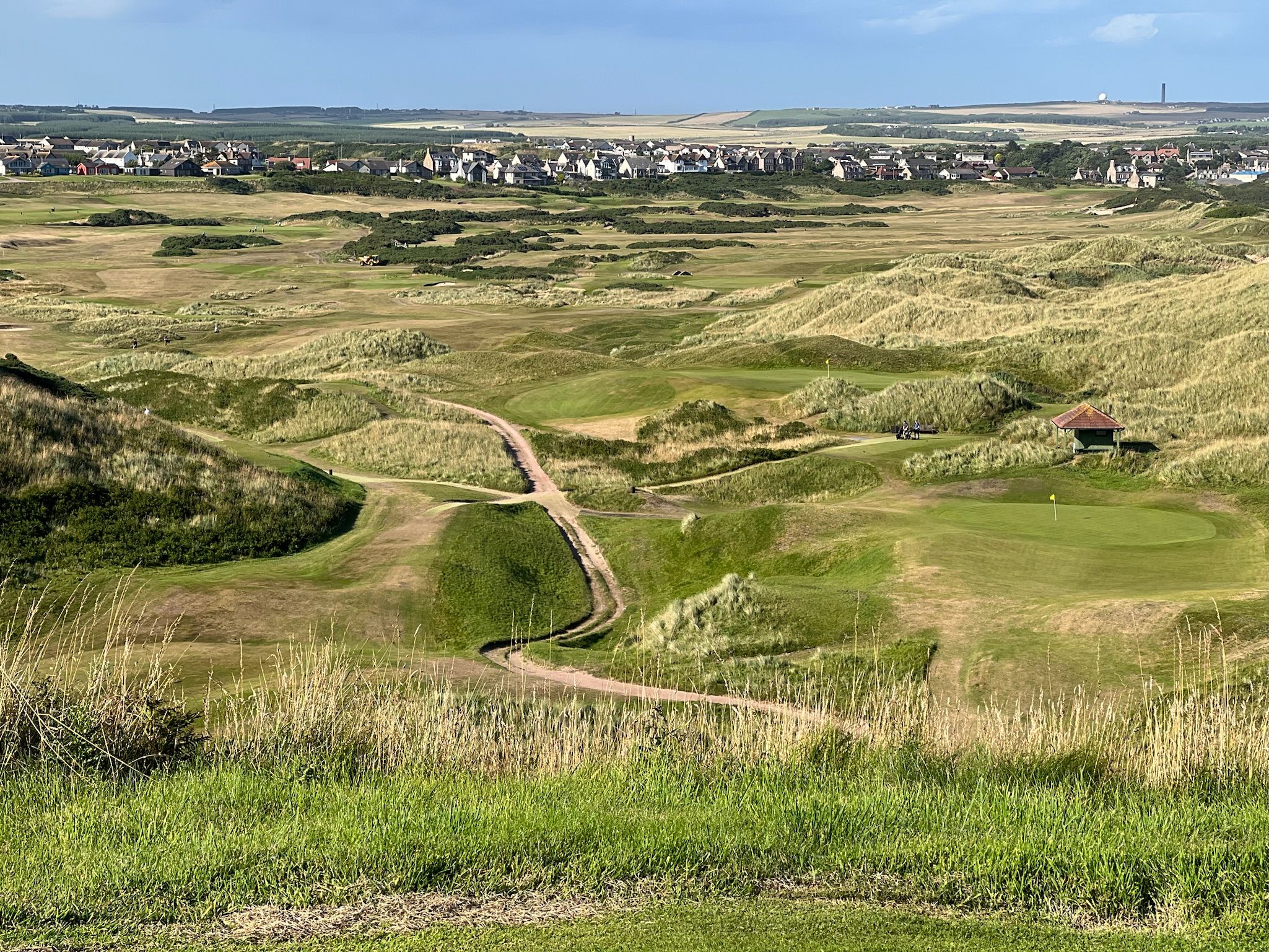
Many people say that the course really begins to get interesting on number four, but do not forget number three, a noticeably short 268-yard par-4 uphill then down with a bowling alley fairway, sloped toward the middle on both sides. The green complex is smallish and deep and the river is behind the green. I never found my drive. River? Anyway, a fun hole to play.
I believe that holes four through seven is my favorite stretch on the course. The beauty and ruggedness of Cruden Bay begins as you walk off the 3rd and approach the 4th tee. A beautiful, uphill par-3. You can either play it from the back tees at 192 yards, or up, which we did at 142. It played more like 170 up the hill with a more hurting wind than the typical prevailing right to left. A five-iron got me over the back of the green to the left for a sidewinding 100’ Texas wedge that I got close enough to drain for a par. You absolutely must carry the ball 10 feet onto the green or it will come all the way back down the hill 40 yards. That was Scooter’s fate. Twice!
This is one of many panoramic holes, with the river and town down the hill to the left, and a fantastic view over the green to wild dunes and the Bay and North Sea beyond with Port Arrel the fishing Village left, and Slains Castle up the hill.
Holes 5 through 7 turn back south toward the clubhouse. Number 5 tee is up on a bluff and you play downhill through the valley, a fun par-4, flanked by dunes and the Bay beyond on the left, and the St. Olaf course on the right.
Number 6 the first par-5, is a beautiful demon of a hole. Angles abound, with a difficult blind 2nd shot. You are third/approach is over the “Bloody” burn (it got its name from a battle between the Scots and Danes over 1000 years ago), to a two-tiered green, guarded by only one pot bunker short-right. What do you do? Pick your angle and trust it. It is a classic Old Tom Morris two-tiered green—make sure you find the tier where the pin is! This hole is on my list of favorite Tom Morris holes, along with #4 Klondyke, a par-4, and #6 Paradise a par-5 at Lahinch, #6 the par-5 at Askernish, and certainly The Alps hole, #17 at Prestwick. The list will continue to grow over time.
Number seven and eight are both fun par-4’s. Number 7 is a dogleg left, an underrated par-4 from the design.
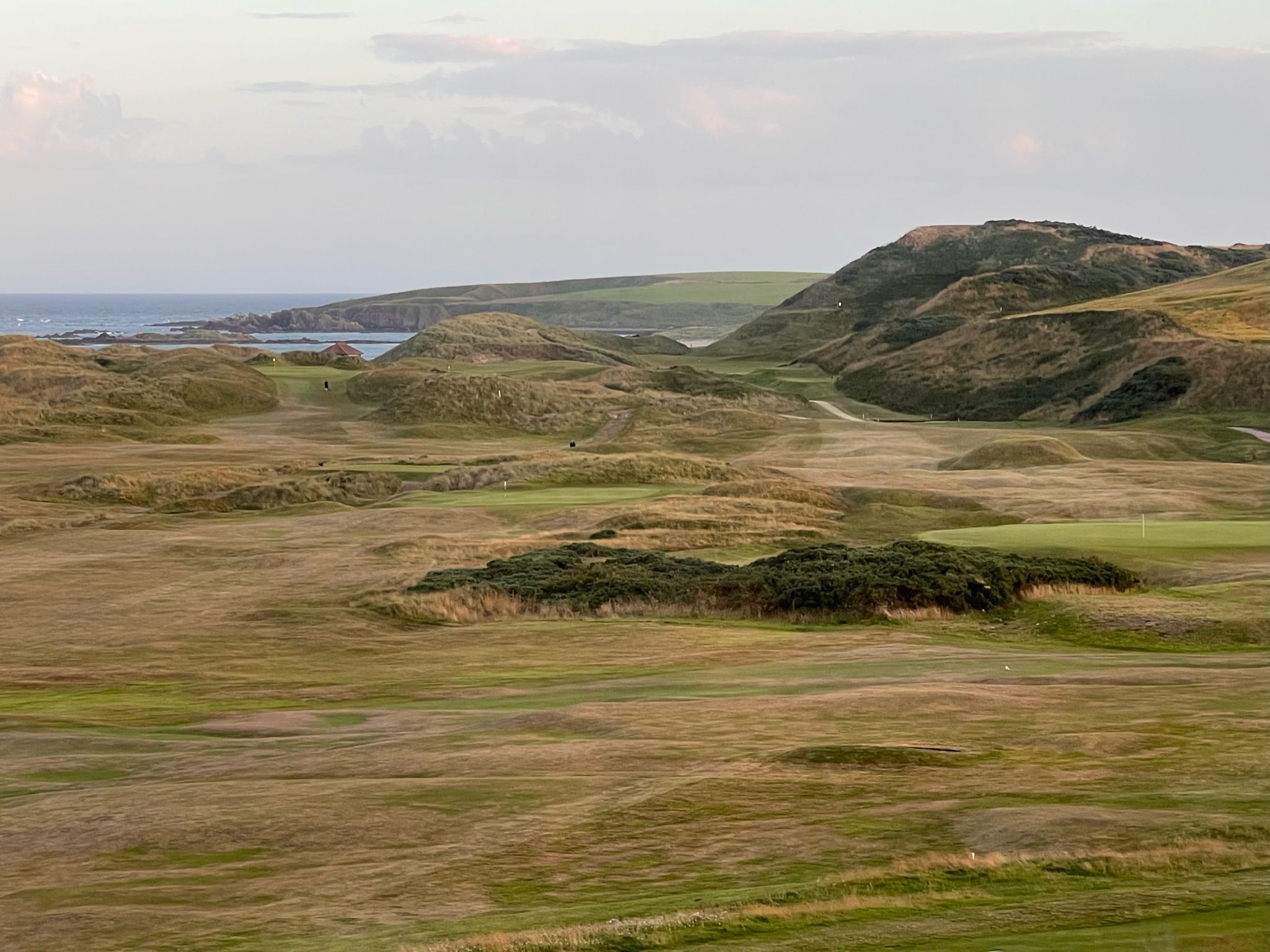
perspective. A narrow, Himalayan-like rippled fairway. with plenty of dunes and trouble on both sides, with a tough uphill approach to a small green, fronted on the left by a huge dune.
Number 8 looks like Old Tom found it and did not touch a thing and simply created a green complex which was a natural amphitheater at the base of the huge dune. It is a another short two-shotter like its brother, number 3, at all of 250-yards.
When you drain your putt, you make the long climb up to #9 tee and get your first glimpse of the beach and the Bay of Cruden beyond. No golf carts or funiculars here, deep breaths and enjoy the climb.
Up top lies Number Nine tee, from which you can see forever—behind and below to the punchbowl green of 14, the par-3 15-green, and the beach backward to Slains Castle. Take note of the pin positions on these greens as they will be blind shots when you arrive there about an hour later.


This is where you get a real shot of adrenaline. You tee downhill to the fairway and green, with a Colorado-like view that goes on forever to your right. Soak it in and take lots of pictures.
It was atop this dune, on this tee that I had the same epiphany as when I played Machrihanish GC, Askernish, Prestwick, and Royal Dornoch. The recurring theme was, put yourself into Old Tom Morris’ mindset from the late 19th century. Designing, or “finding” golf courses required truly little earthmoving, nor was it possible back then. You simply moved or carved dirt with picks, shovels and donkeys. Find green complexes and visualize holes. Make the greens the highlight and the challenge—along with the rippling fairways that diverted shots away from where they were intended. Simple, nothing more, nothing less. The almighty designed this course, Old Tom simply found it.
Number nine and ten take you out to the furthest point on the course and then turn back with the prevailing wind. Number 11 is a fun par-3, then another short two-shotter, #12 at 295-yards, the last hole back against the wind before the final turn back along the water. Thirteen has the last of the three burns meandering across the fairway, a nice, fun par-5.
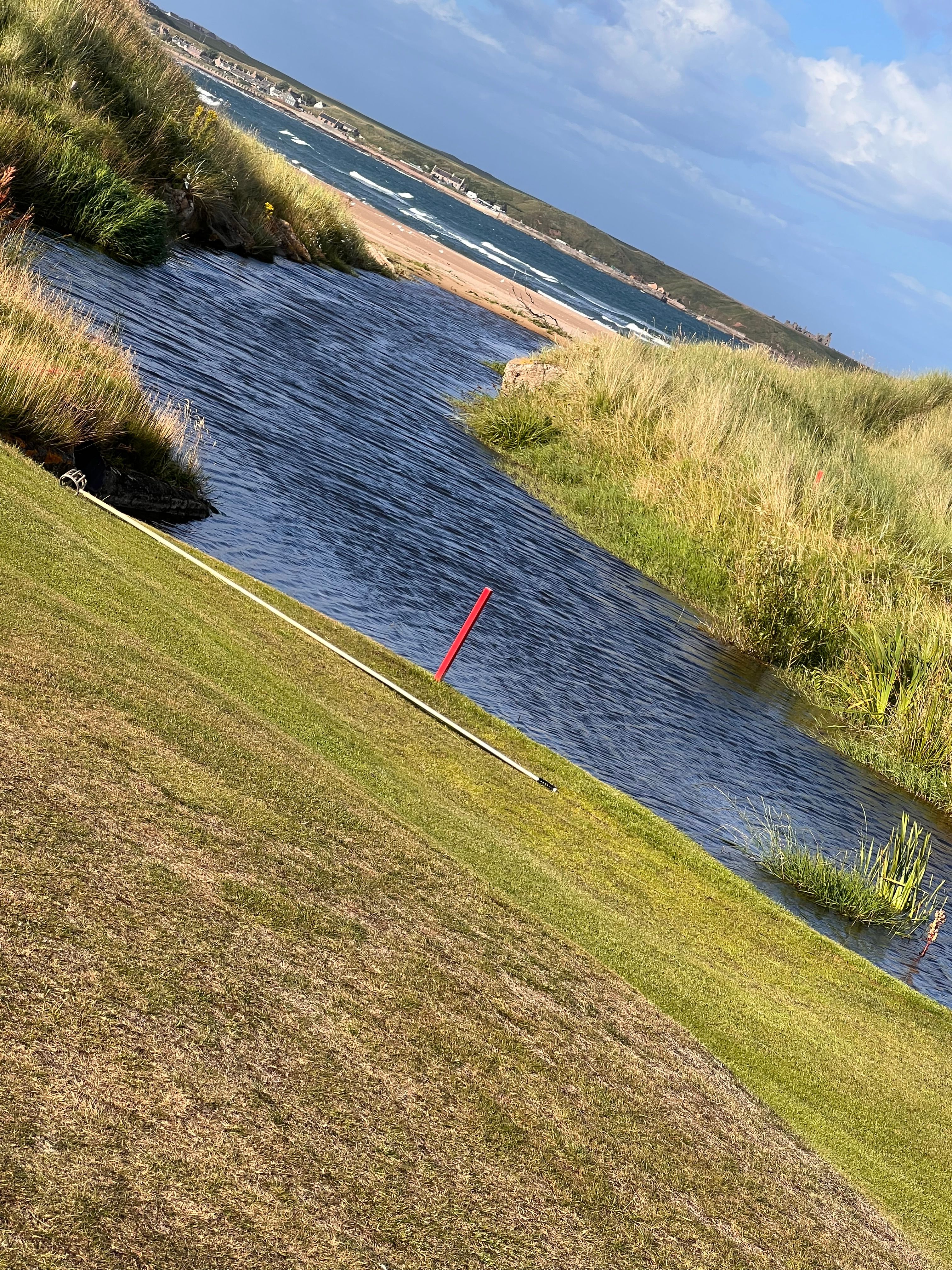
My other favorite hole, #14, is the par-four along the beach, with the punchbowl green. If you glanced down while atop the nineth tee, you would know where the pin position is. It is a narrow fairway, dotted by pot bunkers along the loft side to coax you into favoring the right—the beach is in play just in case. You do not need a perfect approach, just let the bowl funnel the shot somewhere near the hole, just do not be short! Tom Watson dubbed 14 his favorite hole at Cruden Bay back in the 1980’s.
With two consecutive par-3’s ahead, at this point, your toboggan run meets the blind tee-shot, fifteenth, what a great concept. As they say, its only a blind tee shot the first time you play. Aim for the marker, and again, if you peered down from #9 tee, you would know where the pin is. It plays at either 195 or 133 yards. Play the shorter tee unless you are feeling adventurous.
As you head home toward the clubhouse on #17, a nice par-4 has a huge nob in the middle of the fairway that, as story has it, was an ancient Viking burial ground from the Battle of Cruden, again, 1000 years ago.
Enjoy the calm walk up to the 18th and think good thoughts of the wonderful variety of holes you played, and shots you hit over a pint in the beautiful 19th hole. It is hard to rival this panoramic 180-degree view out the course and Cruden Bay.
Summary:
Simply put, Cruden Bay is a wonderfully fun course to play, with beautiful dunes and the typical challenging Old Tom greens and rumpled fairways. Most of all, variety and uniqueness of holes abound. It has quirkiness, and that adds to the experience. How often do we get to play blind shots and/or punch-bowl greens in the U.S.? The punchbowl 14th is one of my favorite holes in all of links golf, and #4 one of my favorite par-3’s, with exceptional views to the wild dunes, and the Bay of Cruden.
This course is classic, and necessary on any trip to Scotland, and there is a reason it is rated #56 in the World, if you care about those ratings. It is only a couple of hours North of St. Andrews, and well worth it. Add in Murcar and/or Royal Aberdeen on the way there or back and you will be a happy golfer!
Rating: Albatross – I could play there every day of my life and it would never get old

View to the North Sea and the top of #9

View to the North Sea and the top of #9


15 Green
— COURSES —
More incredible links courses from Scotland
Old Tom Morris, 1851
An Old Tom Morris designed classic links course that hosted the first 12 Opens, and 24 all told, still rated in the top 70 in the World

Fred Morris
Western Gailes is beautiful, with great routing, fun, challenging green complexes and memorable holes--a classic links course

Old Tom Morris, 1876
Machrihanish Golf Club is one of the most natural links courses you will ever walk. I am quite sure it looks now as if the fairways were when Old Tom Morris first found them 149-years ago. A great routing through beautiful dunes, with undulating, fast and easy to read greens.