
Enniscrone Golf Club
Eddie Hackett & Daniel Steele
A wonderful links course in County Sligo, on the Atlantic Ocean. It has the tallest, most wonderful dunes in all of Ireland



Ireland | Par 72 | 6729 Yards
Harry Colt
Royal Portrush-Dunluce Course
Design: Harry Colt
Yardage/Par: 6729, par 72
Course History:
The club was founded in 1888, as the Country Club, with nine holes. The following year, it was extended to eighteen and it officially became the Royal Country Club in 1892, when the Duke of York—who later became King George V was its patron. It was crowned the Royal Portrush Golf Club in 1895 by his father the Prince of Wales (later became King Edward VII).
It had changed over the years, and the course moved more inland to the beautiful sand hills. They brought in Harry Colt in 1929 for a re-design. Some of Colt’s original holes still exist, but the numbering has been rearranged over the years, as well as the creation of a few new holes.
Royal Portrush hosted the first Open to be held outside of Great Britain in 1951, with Max Faulkner winning the championship. It would be almost 70 years till it returned in 2019, and again last year in 2025.
The Dunluce got its name from the castle just up the coast—close to Giant’s Causeway--which was the ancient home of the Lords of Antrim.
Course Review:
They call them the two big royals of Northern Ireland, Portrush, along with its counterpart in Newcastle, Royal County Down. They are both fantastic courses rated in the top-20 in the World, and deservedly so. I love both of them, however, the experience of playing them is completely different. County Down is a beast, with lots of blind shots through the dunes and I believe it is more difficult. Portrush is more open with fewer blind shots—although you still need to bring your tee game! I make these comments having only played them once and cannot wait to do another comparison after a few more rounds. Our Irish friend Fitzy’s favorite course in the World is County Down.
The artists Van Gogh, Picasso, Cézanne, Gaugin and more, all flocked to Provence, in the South of France because the light is so beautiful there. I think that magical light is very similar on a nice day at Royal Portrush. At the Dunluce Course, the dunes seem bigger, the fairway contours wilder and the colors seem to be exploding in front of you.
It is unique, It amazed me and made me feel happy and alive. Scooter and I caught it on what I call a “Northern Ireland Beach Day.” It had to be around 65-degrees and sunny.
Portrush is visually stunning, very demanding and most of all, very fun to play! It instantly rose into my top ten links courses I would love to play for the rest of my life.
We had a short walk, clubs over our shoulders, from the Golf Links Hotel—which I recommend highly, straight across the street from the clubhouse.
A few interesting characteristics of Royal Portrush, that help add to not only its charm, but its toughness as well:
We were paired with a fun couple from South Carolina, and they had a fun Irish caddie that entertained us with many stories about the course. -
The stretch from 1 through 7 is up there with the best in links golf, including two each of par 3’s and 5’s, and wonderful views to enhance the walk.
The first hole, Hughies, a par-4 of 382 yards is nowhere near being a gentle hand-shake, rather it is terrifying. Ask Rory McIlroy after taking an 8 in the first round of the 2019 Open! There are out of bounds left and right. You have to step up and stripe a drive, then hit a tough uphill iron shot to a very undulating green fronted by a cavern of a bunker, and a huge drop-off left.
After you catch your breath, along comes #2, Giant’s Grave, a wonderful par-5 at 536-yards. Two sets of 3 pot bunkers 290 yards out, and 50 yards short of the green. A very strategic hole.
#3, Islay, par-3, 155-yards has an elevated tee so soak in the views of the entire course and the Atlantic left and beyond to where its namesake Island lies some 35 miles away. The elevated green is very undulating with a bowl and swales that is tough to hit and if you miss, real tough to get up and down. I happened to hit a straight shot, but short of the green by 30-feet which gave me a nice little 100’ punch ‘n run with a five-iron to get up and down for par.
Two fantastic par fours come next. The fourth, Fred Daly’s, is a par-4 at 455 yards and is a monster hole which now stretches to over 500 yards for the big-hitters. You must thread the needle into a somewhat narrow fairway, with out-of-bounds right. A very roller-coaster, rumpled fairway and a beautiful green complex that sits in its own mini-amphitheater.
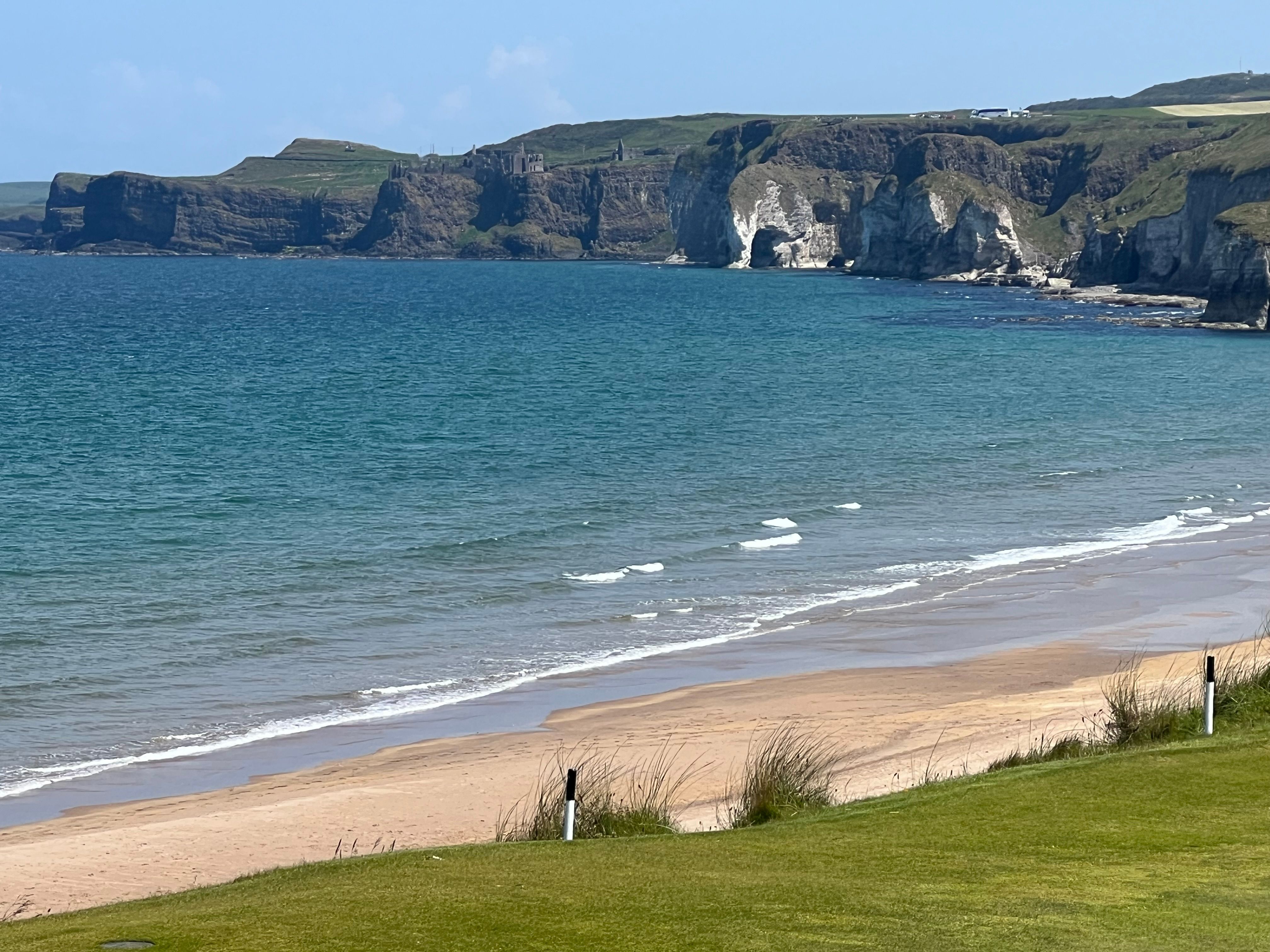
Next comes White Rocks, which is one of my favorites, at 375-yards it runs downhill off the tee then up toward the Ocean, and bends left to right, enabling you to take it over the dunes on the right side, to kick down toward the green. It is truly a great walk, and the infinity green sits suspended up above the beach. It got its name from the view East to the right down the beach to the White Rocks, with Dunluce Castle in the distance.
The last two holes on the great stretch are the par-3, Harry Colt’s, followed by the par-5 Curran Point.
Changes came to the Dunluce Course before the 2019 Open by MacKenzie & Ebert. One of the new holes they designed was the seventh, Curran Point, a 552-yard par five. It plunges through a valley between the steepest dunes on the course—a towering dune runs the length of the right side. A huge, gaping bunker down the right side, emulating the Big Nellie bunker that once fronted the old Harry Colt’s 17th hole.
It was at this point in the round, as we rambled through the dunes, taking in the views and hoping our ball would find the greens, that it felt like we were free falling. The lyrics to Tom Petty’s song Free Fallin’ echoed in my mind, with the strum of the acoustic chorus…as we glided between the dunes on Curran Point:
I wanna glide down, over Mulholland
I wanna write your name in the sky
I wanna free fall out into nothin'
Gonna leave this world for a while
And I'm free, free fallin' Yeah I'm free, free fallin'
All the vampires
Walkin' through the valley
Move west down, Ventura Boulevard
All the bad boys Are standing in the shadows
All the good girls Are home with broken hearts
And I'm free, free fallin'
Yeah I'm free, free fallin'
I had that very same thought and song in my head as I played St. Patrick’s, three days later. Same weather, bright sunlight, and similar gorgeous steep sand dunes! Coincidence? I think not.
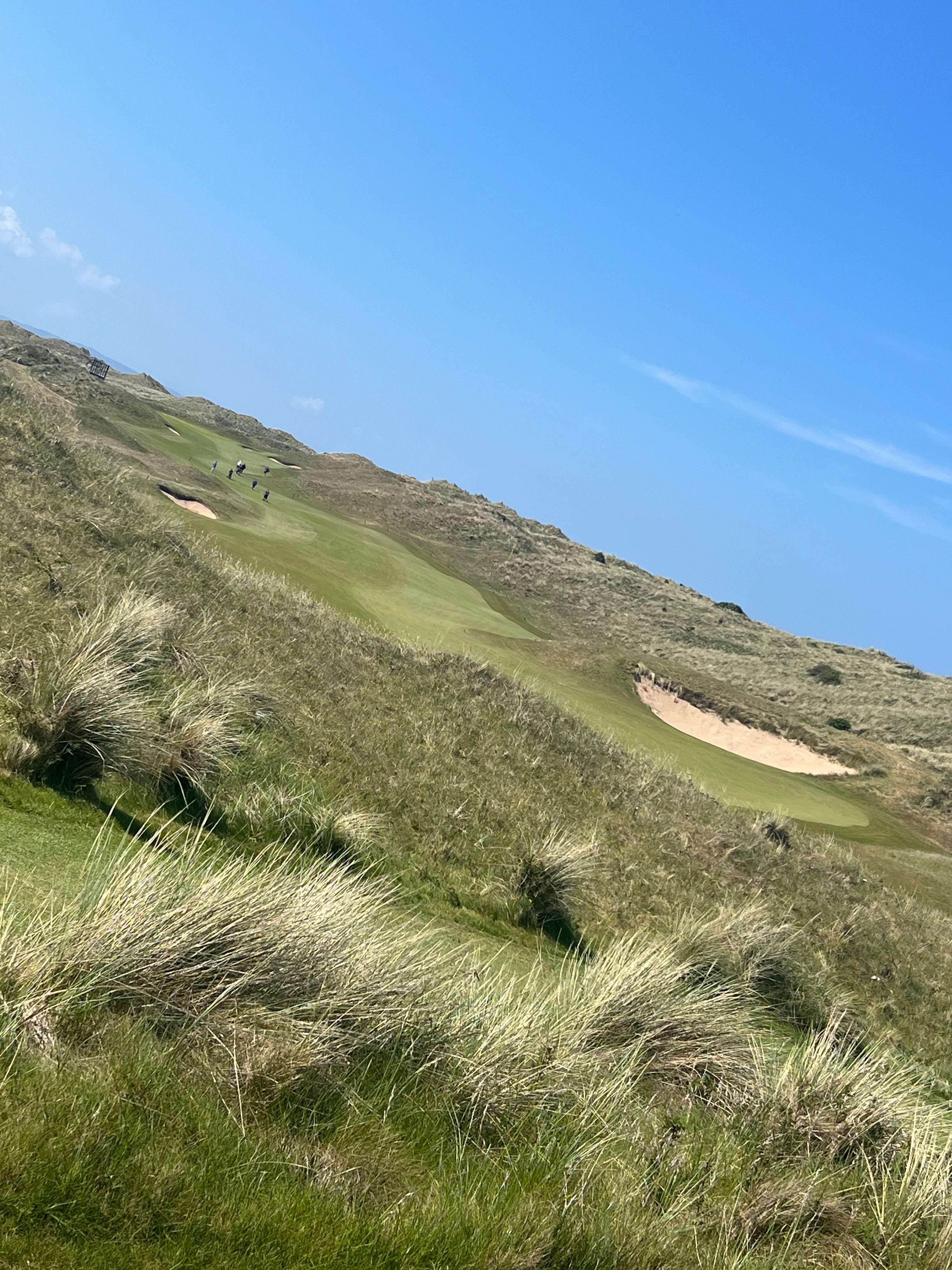
The next set of holes are three robust, dogleg, par-fours, (8-left) Dunluce, (9-left) Darren Clarke’s and (10-right) Himalayas that are all very demanding off the tee. They are in the middle, inland part of the course. If you can get a par or two in this stretch, you are in great shape.
The next two holes are back-to-back par-5’s. Number 11, P.G. Stevenson’s played as a par-4 in the Open, at 472 yards (white tees) and it played as the most difficult hole. Number 12, Dhu Varren, is a long, straight bowling alley of a hole and is as good a chance at birdie as any hole on the course.
Then comes one of the wonderful par-3’s, Feather Bed, which at 165-yards plays some 100-feet downhill from the tee to a front-to-back sloping green surrounded by five wicked pot bunkers. It is up there with the best par-3’s in all of Ireland.
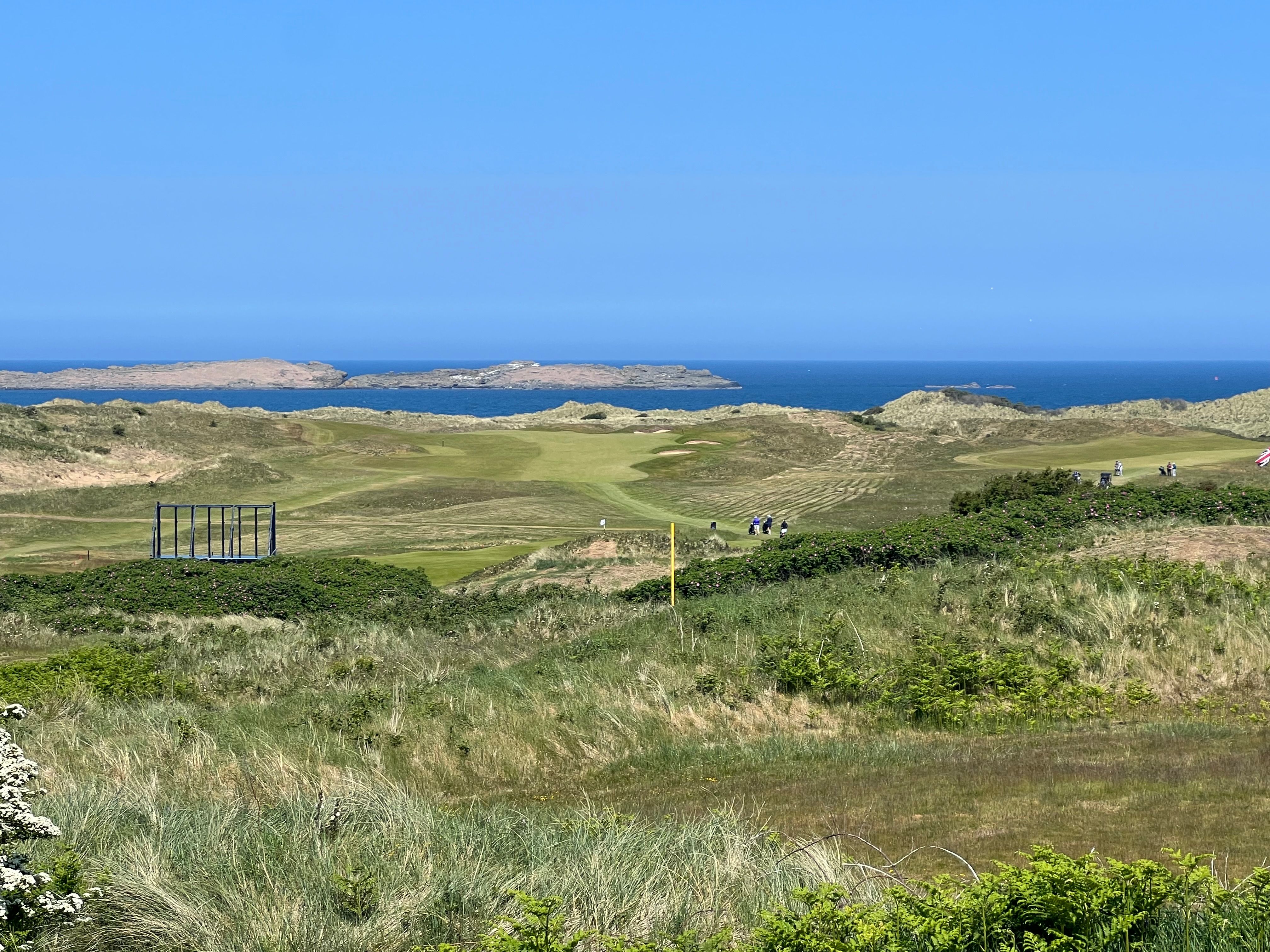
Although the front nine was my favorite, the finishing four holes were all unique and memorable and a thrill-ride to end off the round. Number 15, Skerries, is a strategic dogleg left par-four. The drive is uphill to a plateaued fairway, to which you can choose to cut the corner. The view downhill and out toward the Ocean and Islands in the background has to be one of the best views in links golf. The approach is short, but to a treacherous, small green guarded by a pot bunker left, and steep drop-short and right. As the famous caddie at Prestwick, Chris McBride would say, Golf Shot!
Number 16, Calamity Corner, is the last of the wonderful set of par-threes, and I believe the toughest. Over 200-yards, it is dramatic and intimidating as there is a huge crevasse right that drops down fifty-feet. No bunkers needed here! Your bailout is left, which is what I did, and came to rest in what the caddie called Bobby Locke’s Hallow, after the South African playing it in the 1951 Open—a little depression short and left of the green from where I hit a great punch ‘n run to get up and down for par—just as he did.
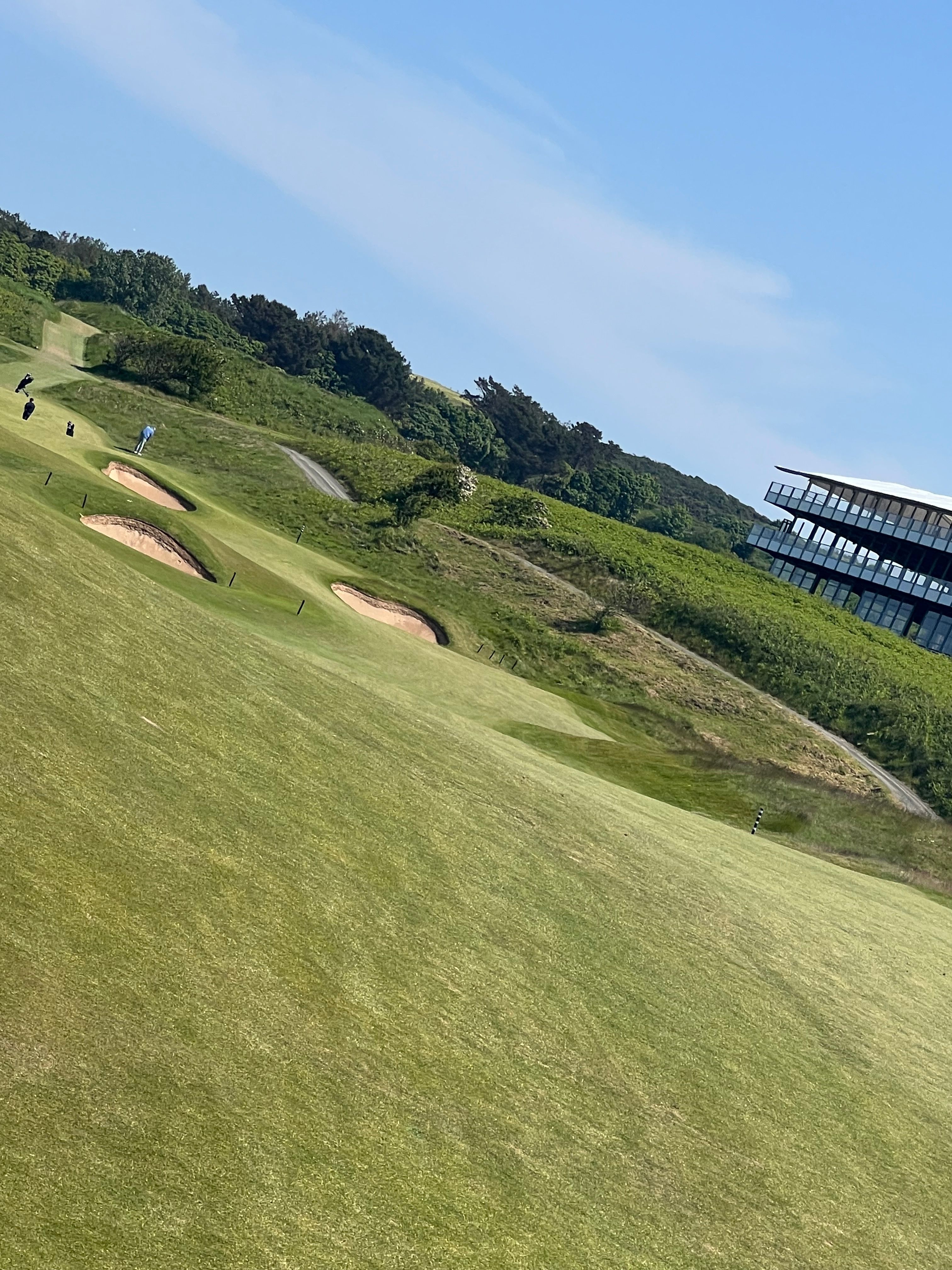
Seventeen, Purgatory, is a short, playful par-four and one of my favorites anywhere. At 360-yards, the drive plays straight away toward the marker behind the green—which backs-up to the par-3 13th, Feather Bed. If you get your drive far enough, you can catch the downslope and get fairly close for a punch shot into the green which is guarded front-left and right by bunkers and has many undulations to make any pin position tricky.
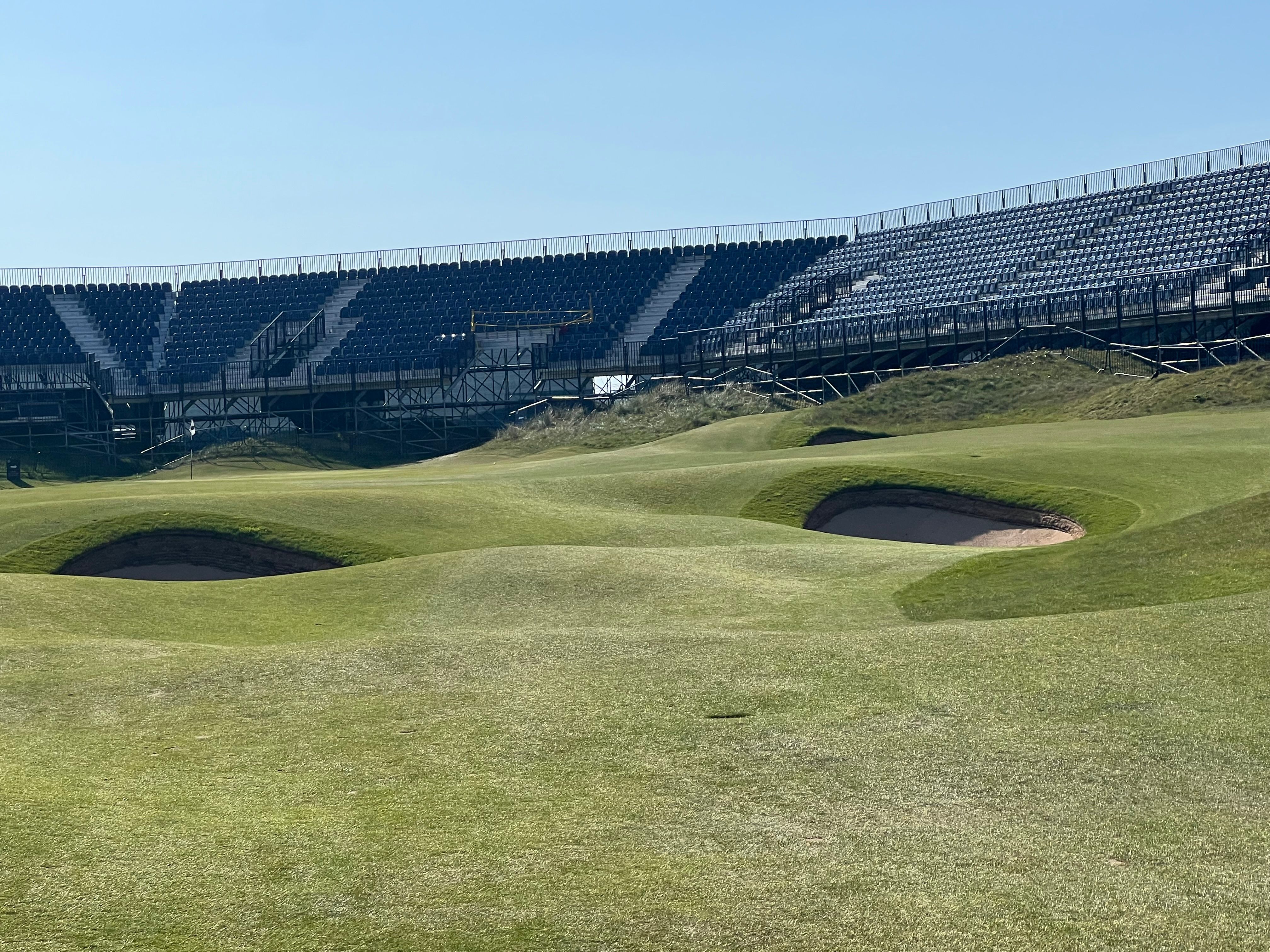
Babington’s, the home hole is a wonderful finish. This dogleg right par-four plays to 426-yards and is challenging. Out of bounds down the left side (with #1 fairway beyond) playing over cross-bunkers about 50-yards out, to a smooth green, that slopes off on the left side. It made for a dramatic view as we were playing the course eight-weeks prior to the Open, with the bleachers as a back-drop.
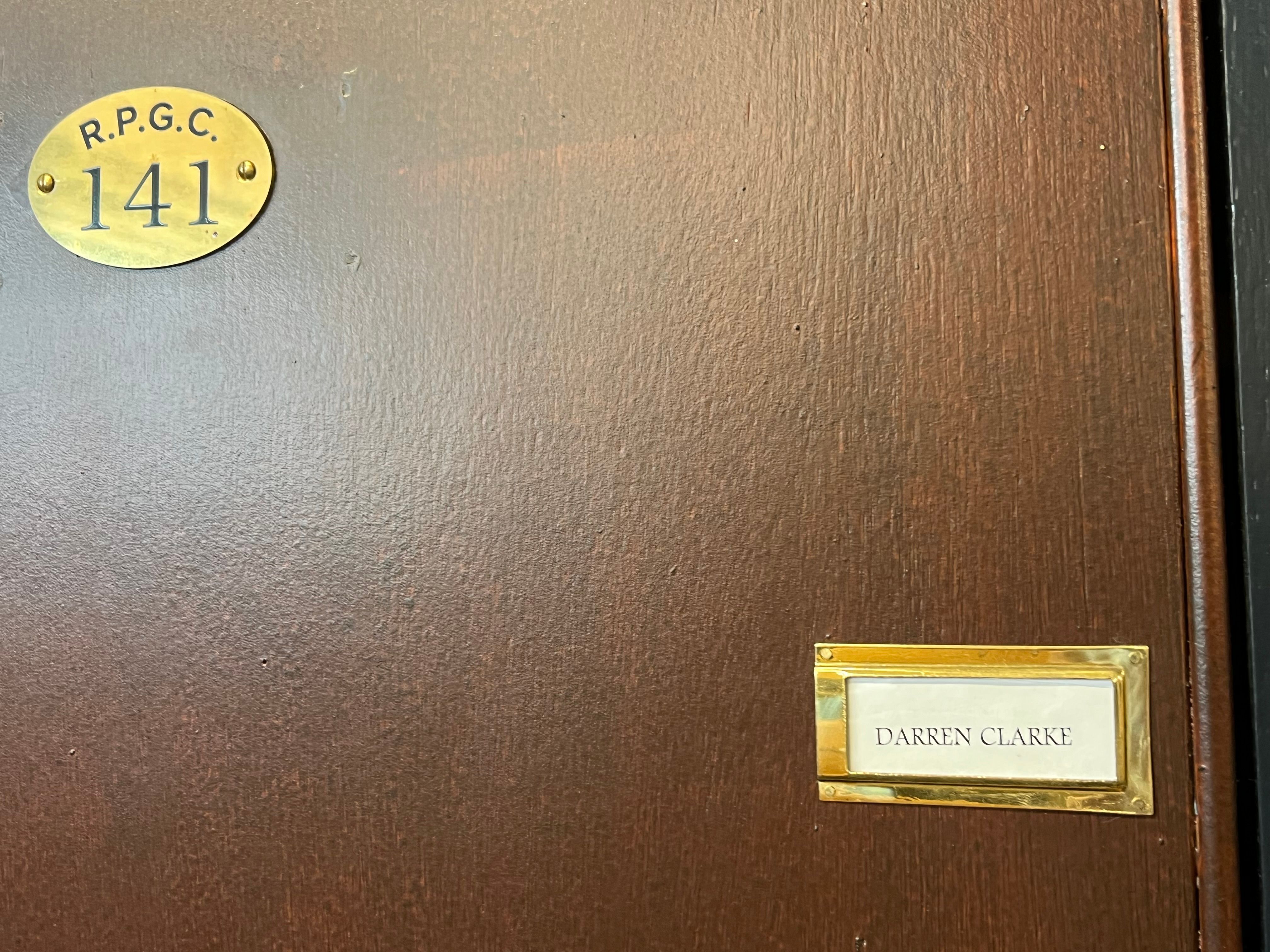
We did not feel exhausted or beat-up after the round, rather exhilarated. It was a challenging kind of fun, and what I like to call a great walk! We had pints in the upstairs 19th hole that was not very crowded on this day. I even ran across this famous Open Champ’s locker.
Every so often the name of the respective links course is tied to its respective towns: Lahinch, Ballybunion, Royal Dornoch, Enniscrone as examples—and this is certainly the case with Portrush. We enjoyed the walk into the town with the Harbor Strand, and its beautiful beach. Its Harbor Bar ranks up there with the best. The small pub downstairs, the ability to grab a pint and sit outside, the History behind the bar, and let’s not forget the raucous dining upstairs that serves-up some of the best fish ‘n chips on the planet. Passing by the kids going to the carnival, with smiles and ice cream all over their faces.
The next time you are in Ireland, head North and take aim at the Dunluce Course.
Course Rating: An Ace, you cannot miss this Top 20 in the World Course—challenging, fun, beautiful and a great walk.

European Ryder Cup Team behind the bar-Harbor Bar

Portrush Harbor

The undulating #3 Green

Try to avoid the wicked gorse

From the 6th tee toward White Rocks

The 19th Hole
— COURSES —
More incredible links courses from Ireland
Eddie Hackett & Daniel Steele
A wonderful links course in County Sligo, on the Atlantic Ocean. It has the tallest, most wonderful dunes in all of Ireland

Pat Ruddy
The masterpiece of designer Pat Ruddy. A wonderful, brutal modern links course with wonderful views of Brittas Bay on almost every hole. A very stern test for golfers at every level

Original (9) Holes: Lionel Hewson, re-design: Tom Simpson
Ballybunion opened in 1893, laid out by golf writer Lionel Hewson. The club battled early media and financial issues, grew to 18 holes in 1926, and saw minor redesigns by Tom Simpson in 1937.