
Prestwick Golf Club
Old Tom Morris, 1851
An Old Tom Morris designed classic links course that hosted the first 12 Opens, and 24 all told, still rated in the top 70 in the World



Scotland | Par 71 | 7208 Yards
George Strath & Willie Fernie & Charlie Hunter
Course History:
Oh, the breezy links of Troon. A wise old Scotsman put it best many years ago:
“O’ a’ the links where I hae golfed frae Ayr to Aberdeen,
On Prestwick or Carnoustie and mony mair I ween,
What tho’ the bests are rough and bunkers yawn aroun,’
I dearly lo’e the breezy links, the breezy links o’ Troon.”
– Gilmour
According to The Breezy Links o’Troon, the club’s official history, there is some evidence of golf being played at Troon from as early as 1870. A meeting was held in 1878 proposing the formation of a golf club.
Charles Hunter, keeper of the green at nearby Prestwick, offered professional guidance on how to convert the unprepossessing scrubland, scattered with gorse (or whin) bushes into a course of six holes.
By 1883, five holes had become twelve and then extended to a full eighteen holes in 1884 by George Strath, Troon’s first club professional. According to the Illustrated Sporting and Dramatic News in 1885:
“The new course at Troon is one which, when there has been a little more trampling, will prove one of the best in Scotland.”
It was Willie Fernie, another influential professional who designed the famous Postage Stamp and Railway holes and oversaw the expansion between 1900 and 1910.
Lastly, James Braid lengthened the course and added more and deeper menacing pot bunkers—changing the dynamic of The Postage Stamp specifically. It is also thought that Alistair MacKenzie gave some advice on the 10th hole while he was consulting.
Troon was granted its Royal designation by Queen Elizabeth II in 1978.
Modern day adjustments (2016) were made by MacKenzie Ebert including major changes to the 9th, 10th and 15th holes.
The first Open Championship was held at Troon in 1923 and has been a consistent presence in the Open Rota over the past one hundred years, hosting it most recently in 2024.
Course Review:
Tam Arte Quam Marte – Royal Troon’s Latin motto meaning “as much by skill as by strength” that appears at the bottom of its crest logo. It was Colin Montgomerie that further reinforced that motto when he once said:
“However, it would be wrong to suggest that Royal Troon is nothing more than a brute because, as successive generations of Open competitors have found, you need finesse and touch as well as strength to play it well.”
Royal Troon is as classic of an out/in links golf course as it comes—but technically it is six out, six crisscrossing, and six in (to the clubhouse). As Tom Watson wrote in his forward to the book, True Links, by George Peper and Malcolm Campbell, that his affection for links golf courses truly blossomed the year after he won The Open at Muirfield, when on a trip with is good friend Sandy Tatum. They played four great ones (and my top four classics), Ballybunion, Prestwick, Royal Dornoch and Royal Troon.
WillieB was out front when Scooter and I arrived on a breezy late Monday morning. We had a quick 45 minutes till we were on the tee, so we dropped our bags outside. He showed us the lay of the land, and then we moved to the hallway of club history, memorabilia, and photographs. It gave me goosebumps looking at all the past Open Champions at Troon. They included Havers (’23), Locke (’50), The King (’62), Weiskopf (’73), Watson (’82), Calcavechia (’89), Leonard (’97), Hamilton (’04) and most recently Henrik Stenson (’16) and X-Man Xander Schauffele, (2024).
Over a quick lunch of toasties and soup, we regaled him with stories of our golfing past in Columbus. Then, it turned to stories of our first leg of the trip down in Kintyre. When the topic of Machrihanish Dunes (the new, most recent Scottish course, designed by David McLay Kidd), a slow, gentle raised eyebrow came across WillieB’s kind face, as he proclaimed.
“My friends that have played there tell me that the greens are like Salvador Dali on an acid trip!”
Thank you David McLay Kidd.
It was certainly the best line of the day, if not the whole 12-day tour of Scotland.
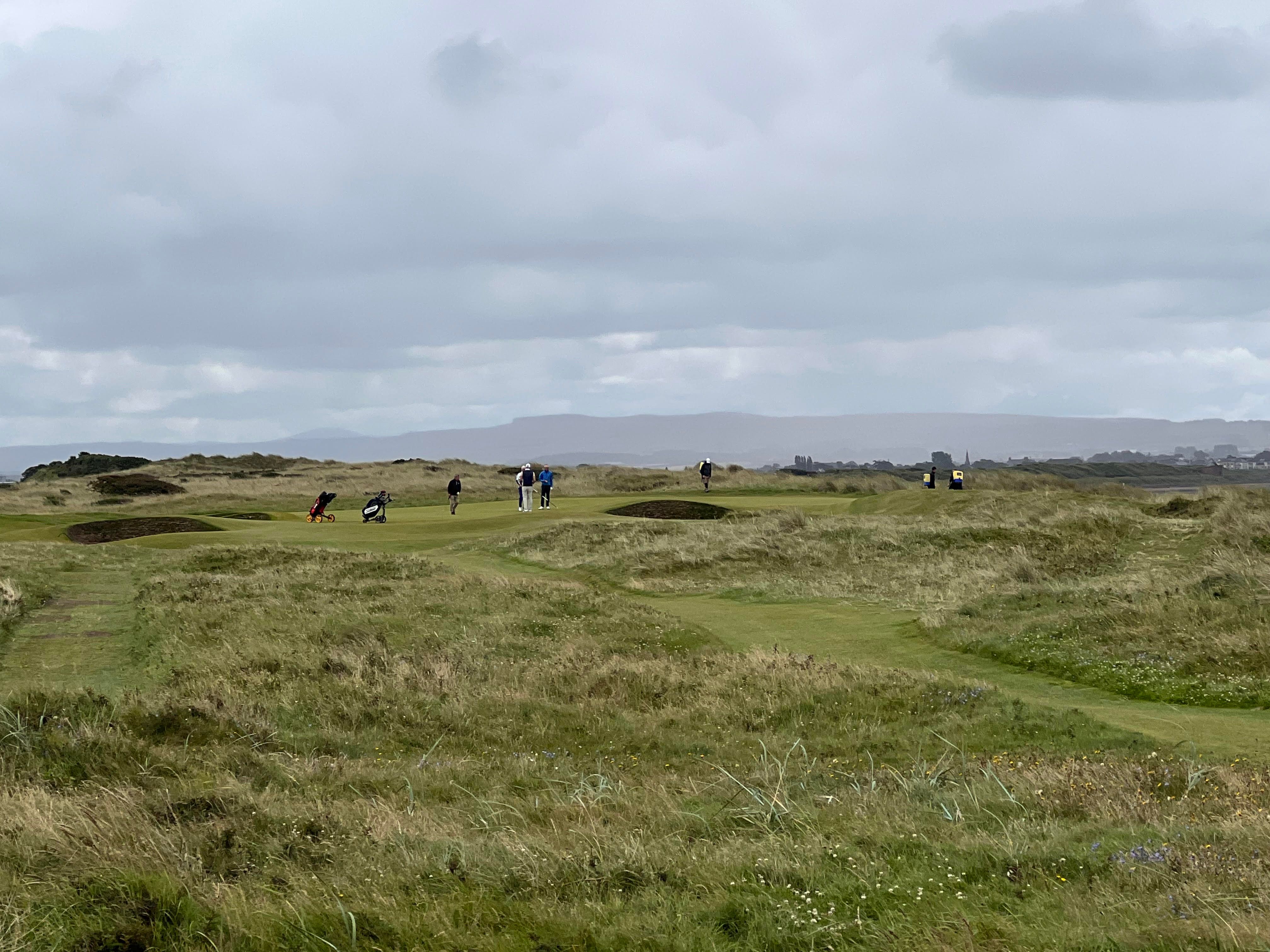
When we made our way around back past the Members’ pro shop toward the first tee, we ran into Rene—a member at Prestwick as well--and his Aussie friends coming off eighteen. We sat next to them at lunch the day before at Prestwick with the Members of the Board of Troon.
“Hugh was on fire today,” Rene said, with a grinning wind-burned face, “must have shot a 75!”
To which Hugh grimaced, and proclaimed in his Brisbane accent, “it was more like a 90!!”
WillieB was on the first tee with a couple of trolleys. His bursitis was flaring up so he would not be able to join us but walked with us the first couple holes—all visitors of Troon are required to play with a member. The wind had picked up in the past hour, and the clouds looked a bit ominous. But we only got a few quick drops and missed all the rain.
When I first played the course, my initial thought was that it is a classic links layout, not unlike Prestwick, with wonderful small greens—difficult to hit, an abundance of wicked bunkers—as many say, the worst, most difficult in all of Scotland—and like every great links course, very memorable holes.
What I did not realize at the time—when you are grinding it out—is Troon’s Infinite complexities that would take a lifetime—or at least 40 or 50 rounds—to understand. Everything is right in front of you, you just simply need to negotiate the rolls, humps, bumps, dunes and wind. Piece of cake, right? Wrong!
The first two holes, Seal and Black Rock skirted the beach and Firth of Clyde and were somewhat of a gentle handshake to get you into the round—except for the killer pot bunkers! WillieB’s bode farewell as we approached our tee shots on #2.
“Hope to catch you for a drink afterward, if at all possible, Lads.”
As explained wonderfully by former professional golfer and golf broadcaster, Iona Stephen in a review of the course. Troon is a course of three acts, thus mirroring Dante’s Devine Comedy. The first six holes represent Heaven, going out along the Firth and the flattest terrain on the course easing you into the round. The second six is Purgatory, climbing into a swirl of dunes and dramatic fate. The third and last six plunge into Hell--a battle of attrition and blasting wind trying to survive and make your way into the clubhouse.
After the three beginning holes that take along the Firth, you come to a par 5/3/5 stretch to end up the Heaven act, before turning inland. Number 4, Danure, is a 555-yard par-5, again, downwind with three deep rivetted bunkers guarding the green. Then comes the par-3 Geenan, a brutal 210-yards from the tips, which is up a bit higher so you get the brunt of the wind—its only bailout long right. Then Turnberry, a par-5 and newest hole on Troon, created by Willie Fernie—combining the old par-4 sixth and par-3 seventh. The green complex tucked nicely into a set of beach dunes. Troon has both the shortest and longest holes on the Open Rota, and this one is a beast!!
Remember earlier when I mentioned that WillieB saw us off the first two holes, and that you are required to play Troon with a Member? Scooter and I were playing quickly, and we noticed the twosome behind us nipping at our heels. They were all over us like white on rice! We could hear the ominous music from the movie Jaws in our heads.
After the group in front of us let us play through on Tel-el-Kebir (#7) we had a good two-hole lead, or so we thought. They appeared again in our rearview mirror as we finished on The Fox (#12). They approached us on the 13th tee as we were waiting on the group in front of us.
After a few tense, not-so-friendly greetings, they inquired as to who we were—knowing that we were not members, nor playing with one. I quickly interjected.
“We are friends of WillieB’s. He played the first couple holes with us, then his bursitis was acting up, so he had to walk in.”
“Oh, no worries. We know him well. How are you enjoying our club?”

Now we plunge into Purgatory. The day before, Danny, my caddie at Prestwick, had told me that holes seven through thirteen were the best stretch at Royal Troon, and he was right on target.
Number seven, Tel-el-Kebir (meaning great mound or hill), was a visually appealing par-4, with an elevated tee and downhill slight dogleg right. It moved back uphill on the approach toward an elevated green complex. The left front greenside bunker was large enough to accommodate a school bus or two.
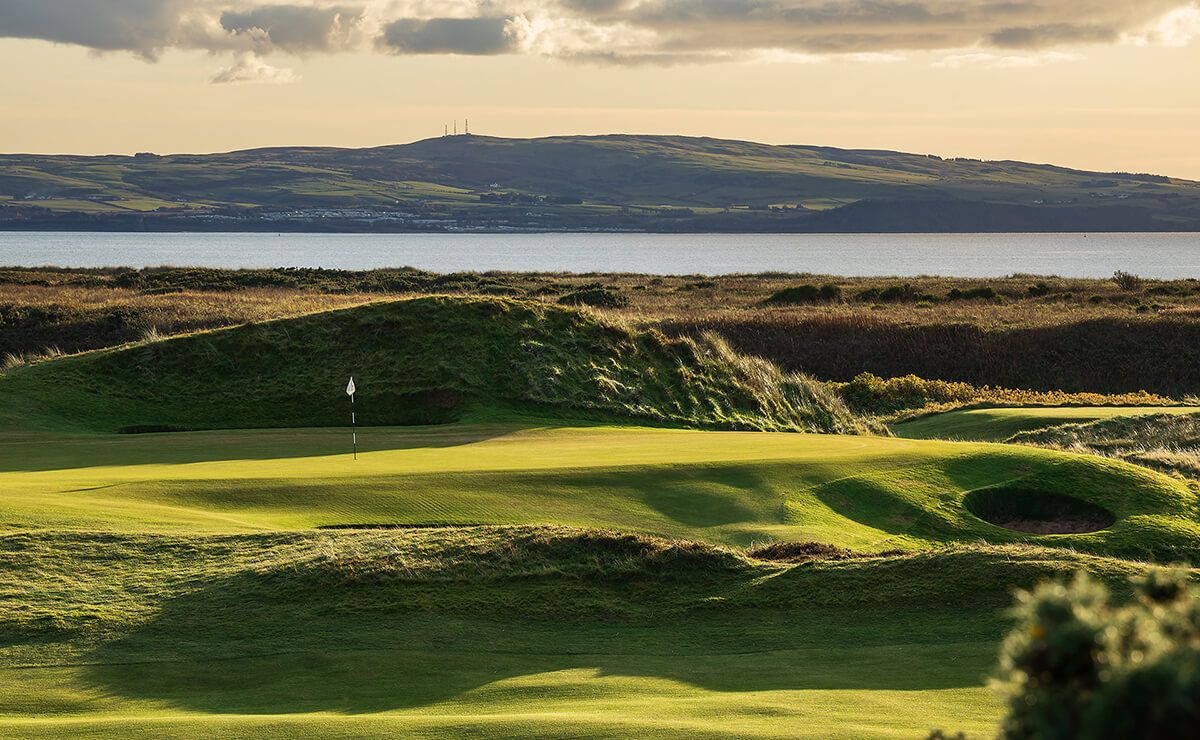
Number eight is the most famous par-3 in all links golf, The Postage Stamp. This became a new hole when Willie Fernie created the new par-5 by replacing the old sixth and seventh. The Postage Stamp is everything that it is cracked up to be. A menacing short 123-yards, downhill shot—to a tiny target surrounded on every side by five deep pot bunkers—and rugged, choppy dunes with a huge sandhill framing the left-side. The Coffin Bunker, below left, being the most famous.
A gut-wrencher of a tee shot in the swirling wind—which gives caddies nightmares—which was significant that day. My result? I tugged it into the left-front bunker, took two to get out, and walked off with a double. I cannot wait to return, just to play this wonderful golf hole. Call me a glutton for punishment.
Then comes a par-4 stretch of four holes, starting with number nine, The Monk, then Sandhills, The Railway and The Fox. Number nine, The Monk, is the furthest south on the course, and over its green, through a trailer park some five hundred yards away is the Ninth tee at Prestwick. Once a year, the members of the two clubs play a 36-hole match, crossing over and back again, stopping for lunch and a pint at Prestwick.
Sandhills is a fun hole. An uphill, blind drive over a beautiful dune to a diagonal fairway, and unbelievably, no bunkers! Then comes the other famous hole, The Railway (that runs along the entire stretch to the green). A beautiful, tight beast of a par-4 at 483 yards—you must pipe a drive and find the fairway. Adding insult to injury, the prevailing wind pushes everything right toward the tracks. It has often been the toughest hole in relation to par on the Open Rota, along with The Road Hole at the Old Course. The Golden Bear himself carded a 10 in the 1962 Open, won by Arnold Palmer.
Number 12, The Fox, turns back south, and gives you one last gasp of air before dropping into Hell, and back into the prevailing wind for the last six holes inward. It is 429 yards, with no fairway bunkers, to a small, two-tiered green.
It was during this stretch of six holes that I had my epiphany that the holy grail of links golf is indeed the walk. It is all about the walk, and what a wonderful walk Royal Troon turned out to be.
Back inward you go, for the third and final act of the play, Hell. it starts with a blast of wind on the 13th tee, Burmah. As I mentioned earlier, this is the battle of attrition. Keep your chin up, and deal with the wicked, hurting left to right wind. My favorite holes on this stretch were 16/17, a par-5, par-3.
Sixteen, Well, at 553 yards, played more like 600. It is a beautiful hole that you start with a drive short of the burn, 250 yards out from the green. The view from North is fantastic with the Firth of Clyde in the background, and the Marine Troon Hotel on the right.
Seventeen, Rabbit, is the last of an impressive set of four par-3’s. At 218 yards it is the opposite of it is little brother, The Postage Stamp. It is a daunting tee shot in the wind, to a slick, fast green. You just cannot miss right, with three menacing bunkers, and the green drops off steeply left into what could be called bogeyland.
Just when your brain is fried and you feel exhausted, then comes the walk down 18, Craigend. It is nothing like the amphitheater of the 18th at The Old Course, but it is a close second. The beautiful clubhouse only steps from the back of the green, full of golfers telling stories.

Now that you have survived the three-act play of Dante’s Devine Comedy, you have earned your 19th hole respite. Just like its neighbor to the south, Troon’s after golf experience was truly epic as well. The members’ bar and dining room was a delight. We sat in the comfortable leather chairs and gazed out to the 18th green to our right, and the Marine Hotel in the background to the left.
As we raised our glasses of Springbank Whiskys, we toasted to how fortunate we were to play Prestwick and Royal Troon, back-to-back. It was the treat of a lifetime! The cherry on top would come later that night when we ran into, had a pint, and swapped stories with The Last Caddie, Chris McBride.
Best-of lists can be a cliché, but Royal Troon is certainly in my top five courses of my list of “if you only had one course to play the rest of your life.” Only topped by Machrihanish GC, Cruden Bay, Ballybunion and St. Patrick’s.
Why Play the Course?
Because it is the ultimate, Devine Comedy of golf. A wonderful, gut-wrenching, mind-blowing, testy, beautiful three-act play. Pure inks golf. A game of attrition. A wonderful, great walk spoiled. A true holy grail of links golf. Take dead aim as soon as you can.
Course Rating: Albatross

Royal Troon Old Course

OldTam and Scooter, on the 2nd 6

Heading into Purgatory
— COURSES —
More incredible links courses from Scotland
Old Tom Morris, 1851
An Old Tom Morris designed classic links course that hosted the first 12 Opens, and 24 all told, still rated in the top 70 in the World

Fred Morris
Western Gailes is beautiful, with great routing, fun, challenging green complexes and memorable holes--a classic links course

Old Tom Morris, 1876
Machrihanish Golf Club is one of the most natural links courses you will ever walk. I am quite sure it looks now as if the fairways were when Old Tom Morris first found them 149-years ago. A great routing through beautiful dunes, with undulating, fast and easy to read greens.